Sunday, February 24, 2013

Is Jesus in the Old Testament?


Duguid, Iain M. Is Jesus in the Old Testament? (Basics of the Faith) Louisville: P & R Publishing, 2013.

Duguid offers a short introduction to the topic of Christ in the Old Testament. Instead of focusing on specific Old Testament passages which are about Christ or show His presence in the Old Testament, he approaches it from a more overview approach and cites numerous New Testament Scriptures to make his points. Our pastor is currently in the midst of a series which is an overview of every book in the Bible. In each Old Testament book we have covered, he has had a section to show Christ in that particular book and points us to specific passages. I think I prefer our pastor's approach to the topic. This is a good introduction, but a book of 40 pages is just not going to be able to adequately address the topic. This review is based on an electronic galley provided by the publisher through NetGalley.

Friday, February 22, 2013

Civil War Cooking

Today we will look at a pair of books on foods of Civil War soldiers.


Dosier, Susan. Civil War Cooking: The Confederacy. Mankato, Minn.: Blue Earth Books, 2000.

A look at the Civil War and foods that Confederate soldiers might have eaten. All recipes have been modernized for today's readers, using appliances such as microwaves.  Still, I think that having children try their hands at making dishes such as hardtack, peanut brittle, and hoppin' john could be a good experience for budding genealogists as they try to understand what the Civil War might have been like for their Confederate ancestor.


Dosier, Susan. Civil War Cooking: The Union. Mankato, Minn.: Blue Earth Books, 2000.

A look at the Civil War and foods that Union soldiers might have eaten. All recipes have been modernized for today's readers, using appliances such as microwaves.  Having children try their hands at making dishes such as johnnycakes, Navy bean soup, and gingerbread cookies will enable them to understand the types of foods that their Union soldier may have encountered during his service. The author probably painted too rosy of a picture of the Union soldiers as she seemed to lead her readers to believe that the Union soldiers never took food (plant or animal) from farms without purchasing it.

This is part of the Friday series on children's literature and genealogy.

Friday, February 15, 2013

Sod Houses on the Great Plains


Rounds, Glen. Sod Houses on the Great Plains. New York: Holiday House, 1995.

A very brief look at the sod house that was often the first home for many pioneer families on the frontier of the Great Plains. The author has included some useful information, but the illustrations are not captivating and the ending seemed a bit abrupt.  Still, this book has some value in showing a child whose ancestor may have lived in such a house what the home would have been like.

This is part of the Friday series on children's literature and genealogy.

Friday, February 08, 2013

Apples to Oregon


Hopkinson, Deborah; ill. by Nancy Carpenter. Apples to Oregon: Being the (Slightly) True Narrative of How a Brave Pioneer Father Brought Apples, Peaches, Pears, Plums, Grapes, and Cherries (And Children) Across the Plains. New York: Atheneum, 2004.

This well-illustrated story of a girl named Delicious whose family travels from Iowa to Oregon taking along their beloved fruit trees. While the story does mention some of the hardships faced on the trail such as river crossings and mountains, the main focus of the book is on getting the trees across rather than the family. I think my greatest problem with the book is that the father seemingly placed a greater importance on his beloved fruit trees than upon his own family. This would be a good read for a young reader whose ancestors traveled the Oregon Trail, but I'd want to tell the child that his own family cared about the fate of the children making the venture than upon the possessions. The story itself is based in part upon a family that did take trees from their former home to Oregon.

This is part of the Friday series on children's literature and genealogy.

Friday, February 01, 2013

The General Store by Bobbie Kalman


Kalman, Bobbie. The General Store. (Historic Communities.)  New York: Crabtree, 1997.

An informative look at 19th century general store and the work of the store owner and his family. The book contains a glossary at the end. Some of the illustrations were drawings; others were photographs. The quality of them varied. As a genealogist who had an ancestor who ran a general store, I found it fairly accurate according to what my mom told me about her father's stories about his father. The author pointed out that many of the store owners also served as postmasters, and this was accurate in my own ancestor's case.

This is part of the Friday series on children's literature and genealogy.

Friday, January 25, 2013

Black Potatoes


Bartoletti, Susan Campbell. Black Potatoes: The Story of the Great Irish Famine, 1845-1850. Boston: Houghton Mifflin, 2001.

While this book may have been aimed at middle school readers, it is a very readable account of the Irish potato famine which led to so many Irish immigrants arriving in U.S., Canadian, and even Australian ports. It is very well researched, yet readable. While it's lack of footnotes may bother adult readers seeking well-documented accounts of the famine, the bibliography does include a discussion of the sources used and how they were used in the work. One must consider its intended audience. It would be a great book to use with a budding young genealogist who has just discovered an ancestor who moved from Ireland  during this time period. The illustrations greatly enhance this book and its appeal. I can picture a young reader asking a lot of "Why?" questions as he or she is reading the narrative. Highly recommended.  (5 stars)

This is part of the series on children's literature and genealogy.

Friday, January 18, 2013

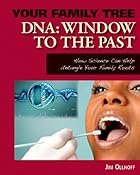
DNA: Window to the Past


Ollhoff, Jim. DNA: Window to the Past. (Your Family Tree) Edina, Minn.: ABDO, 2011.


This book on DNA and genealogy written for children was published less than a couple years ago, yet some of the information is far more dated than that, and some of it was somewhat inaccurate even then. The author addresses only Y-DNA and mtDNA testing and completely ignores autosomal testing which was being offered by all the major players in genetic genealogy testing by that time. The author made a statement about the "two types" of DNA tests saying that "one test is for males, and the other is for females." This statement is completely wrong for the latter. The mtDNA test is offered to both sexes although it will only test the direct maternal line. He later clarifies that it is "usually conducted on females." There is a high enough percentage of males doing mtDNA testing that it is also an inaccurate statement. Some of the photos used to illustrate the book were dated. One such photo was illustrating "current genealogy work on a home computer," yet the photo showed a CRT monitor with a very dated looking genealogy program. I do think that the author's chapter on "Famous DNA Discoveries" would engage young readers. His stories about Christopher Columbus, Captain Cook, and "Cheddar Man" would be useful to use with the young readers.  I would, however, encourage the use of a different book or website to discuss the types of genetic tests offered, even if they are written for adults.

Friday, January 11, 2013

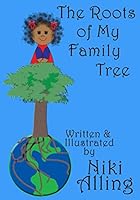
The Roots of My Family Tree


Alling, Niki. The Roots of My Family Tree. Seattle, Wash.: CreateSpace, 2012.

This is a great book to introduce younger children to the topic of genealogy/family history. The book focuses primarily on geographic origins rather than the specifics of researching. It is a book that will create interest rather than a "how to" book. The illustrations which depict things about the countries mentioned provide springboards for discussion of what is pictured in relation to the country.  I was prepared to rate the book higher, but the final sentence was weak and left me a bit disappointed. I still think this book will be interesting to children.  (3 stars)

Friday, January 04, 2013

Letters from the Heart


Bryant, Annie. Letters from the Heart. (Beacon Street Girls, no. 3). New York: Aladdin MIX, 2008.

I read this book because the synopsis mentioned that the students would be involved in a family history project at school. Although I was excited about finding a book for middle school age students about researching their roots, I quickly became disappointed as the details of the girls' everyday existence seemed to play more importance to the narrative than the pursuit of their class project. Although each student finds items relating to their families, there was a lot of missed opportunity in this book to illustrate ways of conducting research. I did like the manner that one student researched the education of African Americans in Boston when she discovered her ancestor had been one of the early African American Boston educators. A lot of the text is gimmicky which would probably be enjoyed more by the intended audience more than by me. This book may work better for some readers than others.  (2 stars)

This is a part of the Friday series on children's books and genealogy.

Tuesday, January 01, 2013

Kiku's Prayer


Endo, Shusaku. Kiku's Prayer: A Novel. New York: Columbia University Press, 2013.

Mitsu and Kiku grew up in a Japanese village just down the road from a village with many Christians. It was during a time in which Christianity was banned, so their elders told them to stay away from the other village and its villagers. One day, Kiku has a chance to meet a boy (Seikichi) from the other village and falls in love with him. She and Mitsu are sent to work for a very demanding employer. Seikichi gives her a medallion of the virgin Mary and tells her to pray to her. Kiku is still not a Christian. She goes to work for the Christians, but still does not become one herself. The Christians are persecuted tremendously. What will become of Kiku and Seikichi? Will she ever realize her dream to marry him? This is not an easy book to read. The persecution suffered by the Japanese Christians in this period of the 1860s and early 1870s was horrific. Of course, the persecution of some of their forebears was as great or greater. One is reminded of the suffering that the Lord endured for all of mankind. Some of the words that Kiku spoke to the virgin Mary made you wish that Kiku had known more of the story of Jesus and the Gospels. She had no idea that Mary knew exactly how she felt as she had watched her own Son suffer. It's definitely more of a Catholic work than Protestant one, but it's one that all Christians should appreciate for the parallels between so many passages of Scripture. I do believe that persons other than Christians can appreciate Endo's work, but I do think the meaning will be richer for those who are more familiar with the New Testament. This review is based on an advance e-galley provided by the publisher through NetGalley. (4 stars)

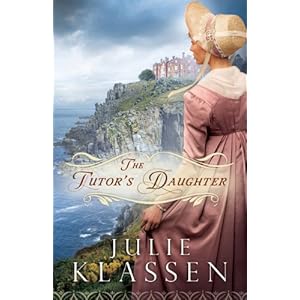
The Tutor's Daughter


Klassen, Julie. The Tutor's Daughter. Minneapolis: Bethany House, 2013.

Emma Smallwood assists her father in his preparatory school for boys. As she's going through the accounts and trying to find ways to bring more students to the school, she notices that the younger brothers of Phillip and Henry Weston have not come as she had expected. When she writes on her father's behalf to inquire if they might be interested in attending, her father receives an invitation to come to Cornwall as their private tutor. Emma is surprised by her father's acceptance, and as soon as their home is rented, they travel to Cornwall only to be to not be met at the station and greeted by a bit of surprise on the wife's part although the letter of acceptance and information about their time of arrival was sent in advance. Emma finds Henry and Phillip away upon arrival although Henry soon returns from his trip on behalf of their estate and Phillip takes a break from his studies at Oxford to come home. Things are disappearing, music is playing, and some try to blame it on a ghost. Emma doesn't believe in ghosts and sets out to prove that wrong. She receives a little help from one of the brothers. As one might expect, there comes a point of danger for Emma and that brother. This novel reminds me so much of the Phyllis Whitney and Victoria Holt novels that I enjoyed in junior high and high school. Many of today's romantic suspense novels add an occultic element to the novel that, as a Christian, I'm uncomfortable reading. Klassen's work gave me the enjoyment of those novels without that uncomfortable feeling. Although this is produced by a Christian publisher, it is not really evangelistic in nature, relying upon prayer in the face of danger and difficulty instead to communicate the faith of the characters. I look forward to going back and reading other books by Klassen now that I've discovered her work. Thanks to the publisher for providing the advanced e-galley of this book through NetGalley.  (4 stars)

Friday, December 28, 2012

Where Did You Get Those Eyes?

Cooper, Kay. Where Did You Get Those Eyes?: A Discover It Yourself Book. New York: Walker, 1988.

A dated introductory genealogy book for children that is probably not going to draw any young person into genealogical research.  (2 stars)

Sorry! Today's review is not a favorable one, and there isn't even a cover image to go along with it.  The book I borrowed had a red cloth binding.  However, we know that not every book published is a winner. This is one of those examples.

This is part of the Friday series on children's literature and genealogy.

Tuesday, December 25, 2012

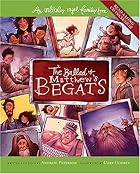
An Unlikely Royal Family Tree


Peterson, Andrew. An Unlikely Royal Family Tree: The Ballad of Matthew's Begats. Nashville: Thomas Nelson, 2007.

While I liked the idea of a children's book based upon the genealogy of Jesus, this one left a bit to be desired. The phrase "he had" was over used, and sometimes in an effort to make things rhyme, things became a bit awkward. The book was conceived as a song and later put in book format. Some annotations were made, but they are nothing that is going to grab a child's attention. The illustrations are better than those of many Christian children's books, but they are not outstanding. I really recommend just getting a children's version of the Bible and reading the account from the Bible to a youngster rather than using this book. There was a CD with the song sung included with the book. It's very acoustical.  (2 stars)

This is a special Christmas day posting for the children's book and genealogy series.

Friday, December 21, 2012

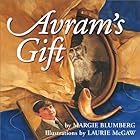
Avram's Gift


Blumberg, Margie. Avram's Gift. Ill. by Laurie McGaw. Bethesda, Md.: MB Pub., 2003.

Mark does not want the photo of his great-grandfather Avram of Russia hanging outside his room. His grandfather tells Mark the story of Avram and his father's immigration from Russia to the United States. A special shofar's horn is part of the family's heritage that plays an important part in this story.  It is nice to see the change that his grandfather's story brought about in Mark's way of thinking.  (3.5 stars)

This is part of the Friday series on children's literature and genealogy.

Friday, December 14, 2012

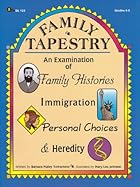
Family Tapestry


Yamamoto, Barbara Maley. Family Tapestry: An Examination of Family Histories, Immigration, Personal Choices, & Heredity. Ill. by Mary Lou Johnson. San Luis Obispo, CA: Dandy Lion Publications, 1998.

This is a collection of reproducible handouts designed for teaching students in grades 6-8. The handouts cover topics relating to social studies, primarily in the study of family history and immigration, and biological aspects of DNA. The book was published in 1998 and as such does not reflect much of the current genealogical understanding of DNA. Most of the information is not really incorrect, it could just be supplemented by some newer material to add to the foundation built with the biological understanding of DNA. The activities provide some great prompts for discussing family history with children of this age. Although the handouts are licensed only for single-classroom use, the book could be used as a workbook in another setting or at home for a child showing interest in his family history.  (4 stars)

This is part of our Friday series on children's literature and genealogy. 

Saturday, December 08, 2012

Cathedral Windows


O'Donohue, Clare. Cathedral Windows. New York: Penguin/Plume, 2012.

This novella, featuring Nell Fitzgerald, centers around 3rd grade teacher, Charlie. Nell is teaching the schoolchildren of Archers Rest piece together quilt squares which will be used for quilts to be sold as fundraisers. When Charlie's home catches fire and it is determined to be arson, suspicion turns to Charlie. Nell is determined to prove that Charlie is innocent so that he can enjoy a Merry Christmas. While it's not great literature nor is it meant to be, it does provide a nice escape with a happy ending which is what many readers want around the holidays. Many people would love to be part of a community such as Archers Rest where people love you unconditionally. I received this as an e-galley from the publisher through NetGalley with the expectation that a review would be written.

Friday, December 07, 2012

Two Continents, Four Generations


Hays, Peter and Rozen, Beti. Two Continents, Four Generations: One Hundred Years, Two Stories. Ill. by Carlos Manuel Diaz Consuegra. 1st English ed. Fort Lee, N.J.: Panamerica Editorial, 2010.

Louis has a school assignment about his family history. He has no interest in his assignment, but his mother becomes very excited as she recalls the story of her Jewish grandfather's immigration from Poland to Brazil just before Poland is captured by the Nazi and his family's escape from Poland just in the nick of time.  The story alternates between 1939 and 2004. The historical portions of the book work far better than the present. The present simply does not flow and is not very plausible.  This one can be skipped by most readers unless the family has a similar migration pattern.    (2.5 stars)

This is a part of our Friday series on children's literature and genealogy. Please note that his book was originally published as Dos continentes, cuatro generaciones in May 2009.  If you have a Spanish speaking child, this story might be useful.

Friday, November 30, 2012

My Mother's Pearls


Fruisen, Catherine Myler. My Mother's Pearls. San Rafael, Calif.: Cedco Pub. Co., 2000.

This is the story of a string of pearls that has been passed down from mother to daughter for generations, identifying each female ancestor in the piece of jewelry's chain of ownership over the years. The illustrations are one of the best features of this book that is certain to please a young girl and have them asking questions about their own female ancestors.

This is part of the Friday series on children's literature and genealogy.

Thursday, November 29, 2012

G Is for Giles County

I had several options for the letter G, but I chose to use Giles County, Tennessee so that I can blog about a location in the Volunteer State.

The Mosley family came to middle Tennessee from Wilkes County, Georgia. At first, they lived in Bedford County. By 1830, they were in Lincoln County. Then in the 1840 census, they are residing in Giles County. 

Sometime around 1840, Walton Harris found his way from Kentucky down to Giles County. The family tradition says that he was on a cattle drive and stopped to water the horses when he saw Margaret and fell in love with her, returning to become her husband after the drive was completed. This is one of those legends that is difficult to prove but there is a bit more detail attached to the story than I've outlined here which proves that something similar happened or that the family is really good at storytelling.

Walton and Margaret continued to make their home in Giles County until sometime after 1855 when they moved to Itawamba County, Mississippi. Their son Charles Newton Harris returned to Giles County a few years later where he lived out his life, dying in the community of Cedar Grove.

Tuesday, November 27, 2012

F Is for Fawn Grove

There used to be a lady named Phyllis Harper who wrote for the Northeast Mississippi Daily Journal (the Tupelo, Mississippi newspaper).  Phyllis wrote a column that was one of my mom's favorite portions of the newspaper. In her column, she wrote about her beloved Fawn Grove, the town in which she grew up. Mom related to Phyllis' description of life in Fawn Grove because the experiences related by Phyllis were so similar to mom's own life. As I began to trace forward my mother's maternal grandmother's line, I discovered that Mom's first cousin once removed on that Harris line lived in Fawn Grove. Finding a family tie to Fawn Grove was special for my mom.

I found a wonderful tribute to Phyllis Harper at http://itawamba360.com/view/full_story/1993782/article-Remembering-my-friend--Phyllis-Harper.  She was the subject of an oral history at University of Southern Mississippi.  Her obituary has also been archived online.

Phyllis did publish a cookbook entitled Country Cooking with Just a Spoonful of Sophistication which mom owned. I also have a copy of this book. I really wish that someone would take the time to publish some of her columns in book form so that I can once again enjoy my visits to Fawn Grove through her writing!