Musings on family history, regional history, book reviews, and miscellaneous observations and comments by a genealogist and librarian living near the Great Smoky Mountains in East Tennessee.
Tuesday, June 26, 2018
Murder at the Mansion
Connolly, Sheila. Murder at the Mansion. (Victorian Village Mystery; 1) New York: Minotaur Books, 2018.
This promising start to a new "Victorian Village" series by Sheila Connolly features Kate who returns to Asheboro after the hotel for which she works sells to new ownership who release Kate and her boss from their positions with nice severance packages. Kate's mission to see how the town can make a turnaround may be impossible, but the key lies in an old mansion now owned by the town. Its previous owner Henry Barton left a generous trust fund to maintain the property. Kate's nemesis, a councilwoman, was murdered. Kate finds herself assisting in the investigation as she examines some important letters she becomes certain the woman found. I loved the mystery but guessed the murderer's identity fairly early. A lot of questions remain unanswered for the readers, indicating the author intends to reveal more solutions to those questions in future installments. While genealogical research was done, the author included few details. Hopefully more will unfold as the series progresses. The series shows promise and should provide mystery-loving genealogists with a few hours pleasure as each book is published. I received an advance electronic copy from the publisher through NetGalley in exchange for an honest review.
Monday, June 25, 2018
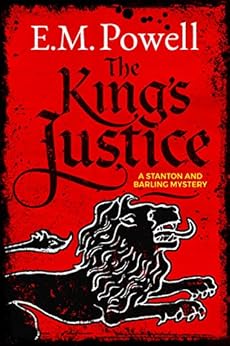
The King's Justice
Powell, E. M. The King's Justice. Seattle: Thomas & Mercer, 2018.
When the manorial Lord comes to seek permission of the king's justices to execute a man charged with murdering the town's blacksmith, the justice's clerk Aelred Barling along with Hugo Stanton, a messenger in the king's service, to make inquiries and serve justice. Stanton does not believe the accused committed the crime, but he's not the one there to give the verdict. Another man is murdered the night the accused escapes from the "gaol." The body count and attempted murder count climbs as the story progresses and the search for the missing man continues.
This was a nicely plotted mystery that held my interest. The guilty party was not immediately obvious although one might suspect the person among several others. The writing is not as strong or tight as it could be. I will probably seek future installments of this medieval mystery series. This review is based on an advance e-galley received from the publisher through NetGalley with the expectation of an honest review in exchange.
Tuesday, June 12, 2018
The Spook in the Stacks
Gates, Eva. The Spook in the Stacks. New York: Crooked Lane Books, 2018.
Once again Lucy, the staff, and patrons of the Lighthouse Library, located on North Carolina's Outer Banks, find themselves in the midst of a murder. The victim,a former area resident who planned to donate his collection of valuable historical documents to the library, dies at a library event, and Lucy finds him. Until the evening of the murder, his finalists list for the collection also included Blackmore College's history department. His granddaughter and curator accompanied him to the Outer Banks, immediately becoming suspects. Lucy's boyfriend Connor seeks re-election as mayor, spending much of his time, campaigning. Butch, the detective, warns Lucy against detecting, but somehow the mystery seeks her out. Louise Jane enthralls guests with her haunting stories of local ghosts while Lucy spots her first one and some inexplicable happenings with a model ship on loan from Louise Jane. Although light and cozy, the book keeps the reader engaged. Some portions, particularly in the first few chapters, seemed a bit repetitious, providing details such as Lucy's living arrangements in more than one location. I received an advance electronic copy from the publisher via NetGalley with expectations of an honest review.
Wednesday, June 06, 2018
Unofficial Guide to Ancestry.com
Hendrickson, Nancy. Unofficial Guide to Ancestry.com: How to Find Your Family History on the #1 Genealogy Website. Revised and updated ed. Cincinnati: Family Tree Books, 2018.
Author Nancy Hendrickson describes using the Ancestry.com site. The book, aimed at new researchers more than experienced ones, contains good comment, but often comes up a bit short. For example, although she cautions new users about accepting information from trees if it appears wrong, she really fails to tell them they should never add the tree as a source but instead should verify the information and add it manually after it is verified. While she is correct that uploading information from a GEDcom file is quicker, she fails to mention reasons for not doing so--and many exist. In the chapters on using AncestryDNA, she fails to mention some of the tips leading genetic genealogists suggest. For example, she tells readers to email those who do not have a tree without telling them how they may be able to find an unattached tree by checking the match's profile or how the connection may be determined by looking at "shared matches." In fact, she never mentions "shared matches." She also failed to mention and caution users about some of the weaker databases such as some of the public records collections lacking dates and some of the collections drawn from older user-submitted sources which contain errors. Of course, the author could not anticipate the problems tree sync users currently experience due to some data migration issues. She could not anticipate the problems with the Rootsweb portions of the site which resulted in long outages for some resources and continuing outages for others. Most supplemental resources suggested appear to be mostly sources from the book's publisher rather than using the "best sources" for acquiring additional subject information. Recommended only for true beginners, but with the caution to supplement with additional resources and webinars to gain a better picture of the power of Ancestry and to understand the genealogical proof standard which did not appear to be a consideration of the author. I received an electronic copy for review purposes from the publisher through NetGalley with the expectation of an honest review.
Tuesday, June 05, 2018
Fire in the Thatch
Lorac, E. C. R. Fire in the Thatch. Scottsdale, Arizona: Poisoned Pen Press, 2018.
This clever mystery featuring Detective Inspector MacDonald sends him to a rural Devon community where Nicholas Vaughan, a very private man, burned in the home he leased. At first glance, it appears to be an accidental fire, but things don't add up in the death of the meticulous and well-liked man. A man who tried to lease or purchase the same property, known as "Little Thatch," questions the man's identity. MacDonald finds the missing pieces, leading to the murderer's motive and identity. This installment is one of the better reads in the British Library Crime Classics series. I received an electronic copy from the publisher through NetGalley with the expectation of an honest review.
Friday, June 01, 2018
What is a "stave dealer"?
Background: Today's post was going to be about a research breakthrough, but I ran into something needing resolution before the intended post can be published. I worked many hours on the problem, but it may require more resources than available online. I'll keep working on it, and hopefully its resolution will be found.
An alternate post needed creation. While researching the problem, I came across an occupation called "stave dealer." I looked up the definition of the word "stave," finding it is a piece of wood used in making barrels. An entry for the occupation "Cooper" in a mid-nineteenth century British publication explained:
Other online sources indicate the stave industry thrived in the United States as well. The stave dealer I found worked in Illinois.
___
* N. Whitlock, J. Bennett, J. Badcock, C. Newton, et al. The Complete Book of Trades, or the Parent's Guide and Youth's Instructor in the Choice of a Trade or Profession . . . London: Thomas Tegg, 1842, pp. 160-161.
An alternate post needed creation. While researching the problem, I came across an occupation called "stave dealer." I looked up the definition of the word "stave," finding it is a piece of wood used in making barrels. An entry for the occupation "Cooper" in a mid-nineteenth century British publication explained:
The business of a Cooper is to make vessels for the safe keeping of liquids. Those vessels are made of different kinds of wood, oak being generally used for the larger vessels where the staves are required to be of great length and thickness. They are cut before they are imported into England from the Baltic, and are sold to the Cooper by the stave-merchant who imports them. Staves are sent here cut to the lengths required for various sorts of vessels, and are sold under the following designations: viz. pipe staves, five feet, six inches in length, two inches thick, and six inches wide; hogshead staves, four feet long; barrel staves, three feet, six inches; there are also long and short headings of various sizes. The stave-merchant sorts them for the Cooper, according to the quality required calling them best and seconds. There are a vast quantity of staves imported from Canada; but though they are finer in the grain and make up better to the eye than the staves of the north of Europe, they are not found to be so durable.*
Other online sources indicate the stave industry thrived in the United States as well. The stave dealer I found worked in Illinois.
___
* N. Whitlock, J. Bennett, J. Badcock, C. Newton, et al. The Complete Book of Trades, or the Parent's Guide and Youth's Instructor in the Choice of a Trade or Profession . . . London: Thomas Tegg, 1842, pp. 160-161.
Wednesday, May 30, 2018
An Impressive Member of the FAN Club
Most genealogists recognize the acronym FAN popularized by Elizabeth Shown Mills. For those not acquainted with the term, FAN represents your ancestor's friends, associates, and neighbors.
Micah Taul, then clerk of courts in Wayne County, Kentucky, granted marriage bonds on 22 Jan 1811 to two couples. The bondsman for Charles Harris to wed Dicey Davis was John Harris, believed to be his father. The bond states Dicey was "of age" and that Charles' parents were present and consented. The other marriage that day was Joseph Mays to Nancy Davis. Presumably Nancy was Dicey's younger sister for John Davis, presumably their father, consented to that marriage. Nicholas Banes served as bondsman. Mays' parents also consented according to the record.
I wondered who Micah Taul was. Born in Maryland in 1785, he moved with his parents to Wayne County, Kentucky, in 1787. His admission to the bar at the age of sixteen in 1801 is notable. He began serving as county clerk that same year. He served as a Colonel in the War of 1812. He served a term as United States representative from 1815 to 1817. He later moved to Winchester, Tennessee where he practiced law and eventually to Talladega County, Alabama where he owned a plantation near Mardisville. Taul's son Micah later served as Alabama's Secretary of State.
Taul wrote memoirs. The originals no longer exist, but they were serialized in the Register of Kentucky State Historical in 1929 and typescripts are available at University of Kentucky and Appalachian State University. Appalachian State's special collections contain letters from a Taul descendant.
____
Sources:
Find A Grave, database with images (https://www.findagrave.com/memorial/25309452/micah-taul : accessed 28 May 2018), memorial for Micah Taul (1785-1850), memorial no. 25309452, citing Taul Family Cemetery, Mardisville, Talladega County, Alabama; memorial created by Bill McKern, 16 Mar 2008.
"Micah Taul," Wikipedia (https://en.wikipedia.org/wiki/Micah_Taul : accessed 28 May 2018).
Micah Taul Papers, 1848-1978. Belk Library, Appalachian State University, W. L. Eury Appalachian Collection, Collection 170. 2 folders. At the time of writing, the special collections web site did not load. Information obtained from Worldcat (https://worldcat.org/ : accessed 28 May 2018).
Micah Taul, then clerk of courts in Wayne County, Kentucky, granted marriage bonds on 22 Jan 1811 to two couples. The bondsman for Charles Harris to wed Dicey Davis was John Harris, believed to be his father. The bond states Dicey was "of age" and that Charles' parents were present and consented. The other marriage that day was Joseph Mays to Nancy Davis. Presumably Nancy was Dicey's younger sister for John Davis, presumably their father, consented to that marriage. Nicholas Banes served as bondsman. Mays' parents also consented according to the record.
I wondered who Micah Taul was. Born in Maryland in 1785, he moved with his parents to Wayne County, Kentucky, in 1787. His admission to the bar at the age of sixteen in 1801 is notable. He began serving as county clerk that same year. He served as a Colonel in the War of 1812. He served a term as United States representative from 1815 to 1817. He later moved to Winchester, Tennessee where he practiced law and eventually to Talladega County, Alabama where he owned a plantation near Mardisville. Taul's son Micah later served as Alabama's Secretary of State.
Taul wrote memoirs. The originals no longer exist, but they were serialized in the Register of Kentucky State Historical in 1929 and typescripts are available at University of Kentucky and Appalachian State University. Appalachian State's special collections contain letters from a Taul descendant.
____
Sources:
Find A Grave, database with images (https://www.findagrave.com/memorial/25309452/micah-taul : accessed 28 May 2018), memorial for Micah Taul (1785-1850), memorial no. 25309452, citing Taul Family Cemetery, Mardisville, Talladega County, Alabama; memorial created by Bill McKern, 16 Mar 2008.
"Kentucky, County Marriages,
1797-1954," database with images, FamilySearch (https://familysearch.org/ark:/61903/3:1:3QS7-893Y-BLFB?cc=1804888&wc=QD3Q-H3V%3A1589735718
: 17 May 2018), Charles Harris to Dicey Davis and Joseph Mays to Nancy Davis, 22 Jan 1811, Wayne County, Kentucky, FHL film 005773126 > image 172 of 707; citing record at Madison County Courthouse,
Richmond.
"Memoirs of Micah Taul," Register of the Kentucky State Historical Society, vol. 27, no. 79 (Jan. 1929): 343-380; vol. 27, no. 80 (May 1929): 494-517; vol. 27, no. 81 (Sept. 1929): 601-627.
Micah Taul Papers, 1848-1978. Belk Library, Appalachian State University, W. L. Eury Appalachian Collection, Collection 170. 2 folders. At the time of writing, the special collections web site did not load. Information obtained from Worldcat (https://worldcat.org/ : accessed 28 May 2018).
Monday, May 28, 2018
Why I Became a Genealogist
In the mid-1980s and from 1989-1999, I lived in Cincinnati. At that time the Public Library of Cincinnati and Hamilton County's collection often appeared in top ten lists of genealogy research facilities in the United States. I always loved history and often saw lots of people researching their family histories as I used the main library.
On one visit home to Mississippi, my mother and grandmother (Nanny) discussed a trip they made to try to find out more about more about Nanny's grandfather Walton (or Walter) Harris. Nanny believed he came from Clinton, Kentucky, or at least that relatives resided there. The family story states he drove cattle to somewhere around Starkville, Mississippi. He stopped to water his horse and the cattle at the Mosely farm in Giles County, Tennessee where he met the woman who became his wife. She and a couple of female friends or relatives sunbathed in view of the men. After the cattle drive, he returned to the farm, taking her as his bride, never returning to Kentucky. I decided to try researching the story, hoping to locate Walton's parents in Kentucky.
Driving cattle from Hickman County, Kentucky, home of the town of Clinton, to Starkville, Mississippi by way of Giles County, Tennessee did not seem a likely route, and early efforts to find a family there which fit known data about his family from other censuses failed. I spotted Clinton County, Kentucky and wondered if Nanny confused the town and county. Clinton County was established in 1835, more than a couple decades after Walton's birth. However, its parent counties held relevant records. I built a case for his parents, based largely on naming patterns. I know I was a newbie researcher and that my case did not meet the Genealogical Proof Standard. I occasionally work on that line, trying to poke holes in my theory, but so far the conclusion reached remains viable.
It appears I inherited more DNA from Walton's wife than from him, but other cousins whose kits I manage hold valuable clues. My matches indicate a connection to the family, but those of cousins hold more matches showing a relation. I look forward to a day of research at Kentucky Department of Archives and History in a couple weeks when I look for additional things to incorporate in my proof argument.
The search for Walton's family ignited an enduring passion for genealogical research. I always did love jigsaw puzzles, logic puzzles, and the mystery genre. Genealogy releases my inner sleuth!
On one visit home to Mississippi, my mother and grandmother (Nanny) discussed a trip they made to try to find out more about more about Nanny's grandfather Walton (or Walter) Harris. Nanny believed he came from Clinton, Kentucky, or at least that relatives resided there. The family story states he drove cattle to somewhere around Starkville, Mississippi. He stopped to water his horse and the cattle at the Mosely farm in Giles County, Tennessee where he met the woman who became his wife. She and a couple of female friends or relatives sunbathed in view of the men. After the cattle drive, he returned to the farm, taking her as his bride, never returning to Kentucky. I decided to try researching the story, hoping to locate Walton's parents in Kentucky.
Driving cattle from Hickman County, Kentucky, home of the town of Clinton, to Starkville, Mississippi by way of Giles County, Tennessee did not seem a likely route, and early efforts to find a family there which fit known data about his family from other censuses failed. I spotted Clinton County, Kentucky and wondered if Nanny confused the town and county. Clinton County was established in 1835, more than a couple decades after Walton's birth. However, its parent counties held relevant records. I built a case for his parents, based largely on naming patterns. I know I was a newbie researcher and that my case did not meet the Genealogical Proof Standard. I occasionally work on that line, trying to poke holes in my theory, but so far the conclusion reached remains viable.
It appears I inherited more DNA from Walton's wife than from him, but other cousins whose kits I manage hold valuable clues. My matches indicate a connection to the family, but those of cousins hold more matches showing a relation. I look forward to a day of research at Kentucky Department of Archives and History in a couple weeks when I look for additional things to incorporate in my proof argument.
The search for Walton's family ignited an enduring passion for genealogical research. I always did love jigsaw puzzles, logic puzzles, and the mystery genre. Genealogy releases my inner sleuth!
Saturday, May 26, 2018
Taking Time To Blog
Life sometimes gets busy. I do not take time to find things to blog nor do I take time to write posts. Early blog posts here did not always include full citations because I did not know how to create footnotes on a blog. It adds time to the creation of blog posts because of the complexity of creating the HTML coding. I want to include citations when needed (and sometimes when not) to ensure adherence to genealogy standards.
Lately book reviews filled my blog. They will continue to be part of it. I need the outlet to fulfill requirements for advance review copies. However, I do not want reviews to become the main thing here as I allowed. After reflecting, I decided on an action plan to reclaim the blog for its intended purpose. I resolve to blog three times weekly about something genealogical or historical in nature. Sometimes the post may take the form of a book review, but I hope most book reviews fall on Tuesdays. I hope to post most other non-genealogy reviews on Thursdays or Saturdays. However, book reviews coincide with book release dates set by publishers. Most fall on Tuesdays, but exceptions exist.
The new plan presently includes genealogy or history posts scheduled to appear on Mondays, Wednesdays, and Fridays. I may include posts other days if I regain the momentum I once possessed. If I'm on vacation or otherwise out of town, the posts may include something about a place I visit or a genealogical reflection on a person associated with the place.
If I fail to keep up with this schedule, hold me accountable! Ask "What's up?" or in some way let me know someone reads and misses the posts. This will encourage me to get back on track. Thank you, readers, for bearing with me.
The Blogger privacy notice only appears when an IP originates in EU countries or if you change the domain to a European one. After I figure out how to use the new pages feature on the updated blog template, I will add one of my own as well. However, it covers the only cookies and such. I removed the "followers" element from the sidebar to increase privacy of readers. I did not know if readers could opt out, so I decided to be safe.
Lately book reviews filled my blog. They will continue to be part of it. I need the outlet to fulfill requirements for advance review copies. However, I do not want reviews to become the main thing here as I allowed. After reflecting, I decided on an action plan to reclaim the blog for its intended purpose. I resolve to blog three times weekly about something genealogical or historical in nature. Sometimes the post may take the form of a book review, but I hope most book reviews fall on Tuesdays. I hope to post most other non-genealogy reviews on Thursdays or Saturdays. However, book reviews coincide with book release dates set by publishers. Most fall on Tuesdays, but exceptions exist.
The new plan presently includes genealogy or history posts scheduled to appear on Mondays, Wednesdays, and Fridays. I may include posts other days if I regain the momentum I once possessed. If I'm on vacation or otherwise out of town, the posts may include something about a place I visit or a genealogical reflection on a person associated with the place.
If I fail to keep up with this schedule, hold me accountable! Ask "What's up?" or in some way let me know someone reads and misses the posts. This will encourage me to get back on track. Thank you, readers, for bearing with me.
The Blogger privacy notice only appears when an IP originates in EU countries or if you change the domain to a European one. After I figure out how to use the new pages feature on the updated blog template, I will add one of my own as well. However, it covers the only cookies and such. I removed the "followers" element from the sidebar to increase privacy of readers. I did not know if readers could opt out, so I decided to be safe.
Tuesday, May 08, 2018
Better Off Read
Page, Nora. Better Off Read. New York: Crooked Lane Books, 2018.
A library with a 75-year-old librarian who still drives a bookmobile (and speeds while doing so)? The set-up for Nora Page's new series features that implausible scenario. The mayor of Catulpa Springs, Georgia,somewhere just north of the Florida state line, wants to do away with its tree-damaged library, its bookmobile, and its librarian. An antiquarian book collector and library friend's death turns suspicion to the man's neighbor. Cleo doesn't believe it and sets out to investigate. Not even Rhett Butler the cat could redeem this book. Far too many characters appear too quickly without sufficient development to sort in the reader's mind. A low-level officer related to one of the characters seems to be the main police officer investigating rather than police detectives or the man referred to throughout the book as "Chief." The conversation-intensive narrative likely appeals to a younger audience while the septuagenarian librarian tries to draw older readers. Unfortunately as someone who recently dealt with aging parents, I question how a town could afford insurance to allow an elderly woman known to speed to drive a bookmobile. While the story does improve as the book goes on, it fails to redeem itself and leaves the reader dissatisfied. I received an advance review copy from the publisher through NetGalley with the expectation of an honest review.
Wednesday, May 02, 2018
Bats in the Belfry
Lorac, E. C. R. Bats in the Belfry. Scottsdale, Arizona: Poisoned Pen Press, 2018.
Bruce Attleton and Mr. Debrette disappear about the same time. Friends and family believe Attleton went abroad, but his luggage and passport turn up in a London studio called the Belfry. Inspector MacDonald investigates. Searchers find a mutilated body in a cleverly disguised location. Although slight doubts about its identity surface, it turns out to be Attleton. Blackmail, affairs, imposters, and more add to the plot. While the book itself suffers from being dated in writing style, the mystery's plot could probably still do well as a movie. It commands the attention of the reader. I received an advance electronic copy from the publisher through NetGalley in exchange for an honest review.
Tuesday, April 24, 2018
The Best Cook in the World
Bragg, Rick. The Best Cook in the World: Tales from My Momma's Table. New York: Knopf, 2018.
Rick Bragg relates family stories as he shares some of his mother's recipes. His mother, like most Southern cooks of that generation, did not follow recipes. She cooked by eyeballing things and getting the ratio correct based on practice. The family stories needed editing. They failed to draw me in, partly because of excess verbiage and lack of action verbs. Most recipes can be found in other Southern regional cookbooks. In the electronic advance copy, the recipe's conclusion often bumps into text following it, making it difficult for readers. The distinction between the recipe and stories about the recipe needs more separation as well. Perhaps his identification of his mother as the best cook in the world elicits the most contentious point of the book. Why? Because my mom in the neighboring state of Mississippi earned that honor. I received an advance electronic copy of the book through NetGalley with the expectation of an honest review.
Wednesday, April 18, 2018
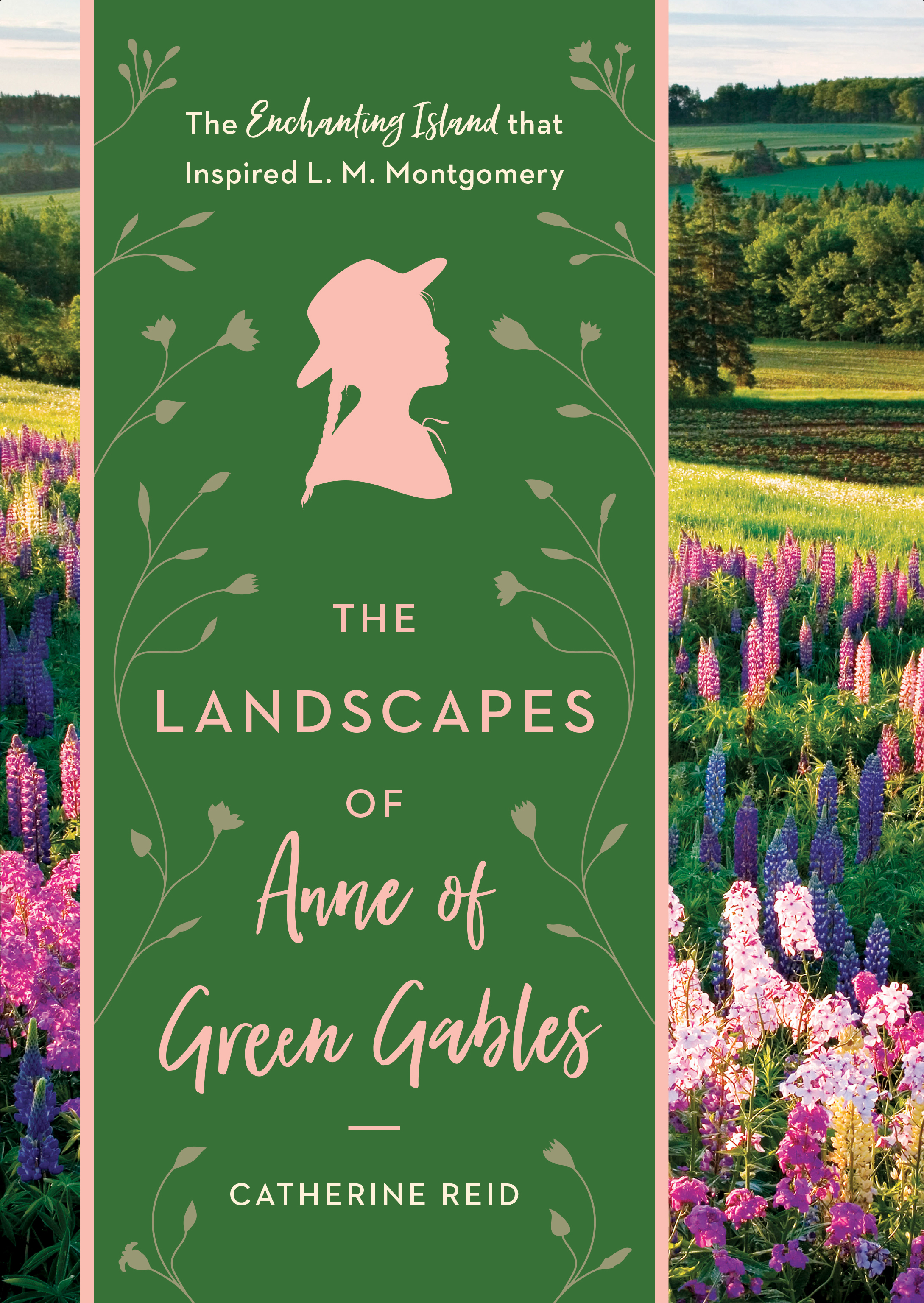
The Landscapes of Anne of Green Gables
Reid, Catherine. The Landscapes of Anne of Green Gables: the Enchanting Island that Inspired L. M. Montgomery. Kerry Michaels, photographer. Portland, Oregon: Timber Press, 2018.
Catherine Reid and Kerry Michaels produced a book which Anne of Green Gables enthusiasts everywhere will welcome. The book's focus is on the landscapes (gardens, woods, lakes, etc.) inspiring Montgomery's settings for the Anne series. Readers see the birch wood in varying seasons. They encounter gardens which inspired the Barry's garden of the books. They see the "Lake of Shining Waters." Gorgeous flower photographs appeal to the eye. The author includes excerpts from the books as she adds details. For academics the author's analysis needs improvement, but fans of the book will treasure the book anyway. Recommended for fans of the series.
Tuesday, April 10, 2018
Macbeth
Nesbo, Jo. Macbeth. London: Hogarth, 2018.
This retelling places Duncan has chief police commissioner in a once-important industrial city infested with drugs, organized crime, and corruption. All the major players have roles in the police leadership. When Duncan dies, Macbeth, the head of the SWAT team, succeeds him as commissioner. The Norse Riders fill the role of a gang. The setting did not work for me. I'm not a fan of gritty noir novels, and this take on the classic Shakespeare fit the category. I received an advance electronic copy through the publisher via NetGalley with the expectation of an honest review.
Wednesday, April 04, 2018
The Family Tree Historical Newspapers Guide
Beidler, James M. The Family Tree Historical Newspapers Guide: How to Find Your Ancestors in Archived Newspapers. Cincinnati: Family Tree Books, 2018.
Well-known genealogist James M. Beidler discusses newspapers as a genealogical source. He covers most types of newspapers. Religious newspapers were omitted from separate treatment although a few titles showed up in a geographic sample in the book. He does an excellent job relating available databases, even acknowledging ethical questions about business practices of some. Beidler, best known for his German genealogical research, includes international newspapers, not limiting the discussion to the United States. The book's greatest flaw lies in the format of the otherwise excellent bibliography. It does not employ a recognized style manual such as Evidence Explained or Chicago Manual of Style. Since one chapter included information on citing newspapers following the recognized genealogical citation manual Evidence Explained, this surprised me. Beidler's work will become the most-cited "how to" guide on newspaper research in the genealogical community in the near future. All genealogy libraries with methodology collections should purchase a copy. I received an electronic advance copy from the publisher via NetGalley in exchange for an honest review.
Tuesday, April 03, 2018
Death by the Sea
Bridge, Kathleen. Death by the Sea. New York: Lyrical Underground, Kensington, 2018.
Liz Holt returns to Indialantic, Florida where her father runs the Indialantic by the Sea Hotel. We meet an odd assortment of characters who appear to find little to do other than drop names of old movies. (How many old titles can be fit into the book? Hundreds, it seemed.) Robbery appears to be the motive when a wealthy guest turns up dead about 40% of the way into the book. This installment failed to make me care about the amateur sleuth, detective, or any other character. I felt the author simply tried to show off her knowledge of old movies. I looked forward to a mystery set in this locale but came away disappointed. Other readers may find it more appealing. I will skip future installments. I received an advance reader's copy through NetGalley with the expectation an honest review would be written.
Portrait of a Murderer
Meredith, Anne. Portrait of a Murderer. Scottsdale, Arizona: Poisoned Pen Press, 2018.
This really wasn't much of a mystery. It's more of a charcter study. The father dies. One of his children committed the murder. We know which one it was and how it was done. He's just trying to hide it from his siblings. I really disliked the entire family. It simply did not resonate well with me; however, persons who like to see character drive the story may enjoy it. It's labeled as Christmas crime. Just because the murder happened at Christmas when the family gathered does not make it a "Christmas" story. This one could occur at a family reunion any other time of the year. This is based on an electronic galley provided by the publisher through NetGalley with the expectation of an honest review.
Tuesday, March 27, 2018
Murder, She Knit
Ehrhart, Peggy. Murder, She Knit. New York: Kensington Books, 2018.
In this promising start to a new series, widowed Pamela Paterson invites her husband's former colleague Amy Morgan who recently took a job with a local college to her home for the weekly knitting group meeting. When Amy doesn't show up, Pamela assumes something came up at the university. Later that evening while looking for the cat's bowl, she discovers her friend's body in the shrubbery with a knitting needle poking out of her body. The needle seems to point to someone in the group, but Amy made some controversial decisions during her short time chairing the department, supplying suspects outside the frame of the needlework circle. Pamela doesn't think police always ask the right questions and begins to investigate with the help of neighbor and fellow knitter Bettina.
The conclusion of this one caught me a bit by surprise although I confess to coming up with no solution of my own. The clues were present, but not obvious. I'm a bit baffled why the police did not interact with Pamela more and warn her about sleuthing. I loved the cat who adopted Pamela and look forward to Catrina's becoming more comfortable around her pet human. The main characters and setting were well-developed. I look forward to the next installment of the series and to seeing how the characters develop over the course of the series. I received an advance electronic galley from the publisher through NetGalley with the expectation of an honest review.
Tuesday, March 20, 2018
From Jerusalem to Timbuktu
Stiller, Brian C. From Jerusalem to Timbuktu: A World Tour of the Spread of Christianity. Downers Grove, Illinois: IVP, 2018.
When the subtitle discussed "the spread of Christianity," I expected the title to be more focused on a history of missions. Instead this book organizes itself around topics and then highlights a few places around the world under each. It is specifically focused on Pentecostal missions with the Nazarene tradition being emphasized. This limits the audience for the book. I disagree with the author's interpretation on several theological points. While the book does contain some historic content, the non-chronological arrangement makes it unhelpful as a history of missions. The content organization reminded me of sermons with specific points with illustrations drawn from specific missionaries or global settings used to engage the audience. This book is probably most useful in an introduction to missions course, a Pentecostal church missions group study, or in a theology of missions course in a Nazarene institution. This review is based on an electronic galley received by the publisher through NetGalley with the expectation of a review.
Death Comes in through the Kitchen
Dovalpage, Teresa. Death Comes in through the Kitchen. New York: Soho Crime, 2018.
Stupid San Diego journalist gets involved in a virtual relationship with a Cuban food blogger and thinks he is going to marry her. He arrives in Cuba with a wedding dress. She doesn't meet him at the airport, and when he arrives at her place, she's dead. The story goes downhill from there. The Cuban authorities think he's a government spy. He discovers his beloved is also seeing another man. He has no rights because he's in Cuba during a time before the United States resumed relations with the country. The dead girl is not who she appeared to be. The book falls flat, fails to engage the reader, and wastes paper or bandwidth. I received an advance reader's copy through NetGalley in exchange for an honest review, and that is the only reason I kept reading it.
Subscribe to:
Posts (Atom)