Musings on family history, regional history, book reviews, and miscellaneous observations and comments by a genealogist and librarian living near the Great Smoky Mountains in East Tennessee.
Sunday, November 10, 2019
The Manor House Murder
Martin, Faith. The Manor House Murder. London: Joffe Books, 2019.
Monica and husband Vicar Graham attend a clerics conference at a manor house. A cleric who mentioned a nut allergy dies after eating a dessert infused with peanuts. The chef is appalled someone tampered with his dessert. Monica, convinced Chief Inspector Jason is on the wrong track, begins her own investigation. We see more of Jason's investigation than Monica's. Too many characters and dull writing make this a struggle to read. A few places showed promise but the narrative's flatness returned too quickly. I did not read previous installments in the series so it's possible that affected my enjoyment as well. I received an advance review copy through NetGalley in exchange for an honest review.
Saturday, August 31, 2019
The North-East of England
Worker, Julian. The North-East of England. (Travels through History). n.p.: Andrews UK Limited, 2019. [Print edition by AG Books, 2018]
Only a few sites in northeast England garner inclusion in this short work by Julian Worker. The author chronicled his own travel, including a few interesting facts about the sites visited. The publisher's website claims it is "the UK's leading independent publisher." The book needed extensive editing to cut down on "be" verb use, excessive words, and overuse of passive sentence constructions. I received an electronic copy through NetGalley with expectations of an honest review.
Thursday, April 18, 2019
Mr. Finchley Discovers His England
Canning, Victor. Mr. Finchley Discovers His England. 1934. Reprint, Richmond, United Kingdom: Farrago, 2019.
Mr. Finchley who serves as clerk for a London firm finds himself taking a 3-week vacation for the first time in years. The new manager insisted he take it. He books himself for a trip to Margate, but from the beginning of his trip things take a strange turn. Mr. Finchley finds himself in one adventure after another. Mr. Finchley is not one to be on the wrong side of the law, but he finds himself skirting it on several occasions because he is too trusting of shady characters he encounters along the way. The humor comes mostly from seeing what one considers a straight-laced person in the situations in which he finds himself. He learns quite a bit about himself along the way. The novel is not a new one. It first appeared in print in 1934. Although I enjoyed the book, I found it was one I could easily put down. I received an electronic galley in exchange for an honest review of the book.
Tuesday, December 04, 2018
The Arsenal Stadium Mystery
Gribble, Leonard. The Arsenal Stadium Mystery. Scottsdale, Arizona: Poisoned Pen Press, 2018.
When a soccer player collapses and dies at a London stadium, it is up to Inspector Slade to catch the killer. He always gets his man. With little cooperation from those most likely to know anything useful, it is challenging. The man was not popular, and motives or potential motives abound. Slade suspects the murder is connected to the death of a girl a few years ago. He just needs to make the puzzle pieces fit . . . and he finally does. I enjoyed this Golden Age mystery and would love to read more books with Inspector Slade. I received an advance electronic copy from the publisher through NetGalley with the expectation of an honest review.
Monday, June 25, 2018
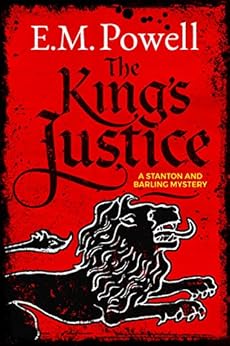
The King's Justice
Powell, E. M. The King's Justice. Seattle: Thomas & Mercer, 2018.
When the manorial Lord comes to seek permission of the king's justices to execute a man charged with murdering the town's blacksmith, the justice's clerk Aelred Barling along with Hugo Stanton, a messenger in the king's service, to make inquiries and serve justice. Stanton does not believe the accused committed the crime, but he's not the one there to give the verdict. Another man is murdered the night the accused escapes from the "gaol." The body count and attempted murder count climbs as the story progresses and the search for the missing man continues.
This was a nicely plotted mystery that held my interest. The guilty party was not immediately obvious although one might suspect the person among several others. The writing is not as strong or tight as it could be. I will probably seek future installments of this medieval mystery series. This review is based on an advance e-galley received from the publisher through NetGalley with the expectation of an honest review in exchange.
Wednesday, May 02, 2018
Bats in the Belfry
Lorac, E. C. R. Bats in the Belfry. Scottsdale, Arizona: Poisoned Pen Press, 2018.
Bruce Attleton and Mr. Debrette disappear about the same time. Friends and family believe Attleton went abroad, but his luggage and passport turn up in a London studio called the Belfry. Inspector MacDonald investigates. Searchers find a mutilated body in a cleverly disguised location. Although slight doubts about its identity surface, it turns out to be Attleton. Blackmail, affairs, imposters, and more add to the plot. While the book itself suffers from being dated in writing style, the mystery's plot could probably still do well as a movie. It commands the attention of the reader. I received an advance electronic copy from the publisher through NetGalley in exchange for an honest review.
Tuesday, September 26, 2017
This Side of Murder
Huber, Anna Lee. This Side of Murder. New York: Kensington, 2017.
Verity Kent goes to an English island with some of her husband Sidney's acquaintances from the war. A letter accusing her late husband of treason caused her to go. She discovers the men are hiding something. A coded message is found in a book that belonged to Sidney. The gardener was a man Verity knew well, and his presence adds an interesting twist to the situation. I tolerated this book. The plot was just too convoluted. It reminded me of locked room mysteries, but it was not as well-written as many of those. I received an electronic advance reader's copy from the publisher through NetGalley with the expectation of an honest review.
Saturday, December 05, 2015
Murder by Matchlight
Lorac, E. C. R. Murder by Matchlight. Mineola, New York: Dover, 2015.
This reprint from the Golden Age of Mysteries features the death of a man known as John Ward on a bridge. Although witnesses catch a glimpse of the murder, his identity is unknown. A small pool of suspects, most of whom reside in the house with the man known as Ward, are interviewed by Inspector MacDonald and his colleagues. Evidence points to "John Ward" being an assumed name and another identity is found for the man which begins to yield motives in the group. While some of the characters could have been a bit more developed, others are sufficiently developed. Although it is not a particularly complicated mystery, it is enjoyable. Dover Publications is doing a great service providing better access to this and other mysteries of the Golden Age. This review is based on an Advance Readers Copy provided by the author through NetGalley with the expectation a review would be written.
Tuesday, August 30, 2011
The Legacy by Katherine Webb
In a parallel story covering the early part of the 20th century, we learn that Caroline, a woman from New York, married an Oklahoma rancher, and traveled west to meet him and live. We learn of the trials and tragedies of the short time she spent out west before she left the area and what prompted her to hide that part of her life from her descendants.
I really enjoyed the Oklahoma portion of the novel far more than the contemporary portion and would have liked to have seen it be the star of its own novel. The contemporary sections were not as engaging, and the manner in which they were presented sometimes made it hard to determine if it was 20 years ago or present-day since the characters involved were the same. It is also clear that there were repercussions of Caroline's past in the manner in which she treated those around her, including her own daughter. As a genealogist, I was also disappointed that Erica, as she began her search, did not try to research American records to determine if there had been a previous marriage and to see where this might have taken her. There were certainly enough clues interspersed throughout the narrative that would have led me to several sources which would likely have told more of Caroline's story for her descendants. I certainly appreciated Erica's consulting with a relative who had done some family history research, but it was clear that the author did not seem to understand genealogical problem solving.
Recommended for persons who can appreciate the historical aspects of the story without being too disappointed in the disjointed nature of the contemporary story. This review is based on an Advance Readers Copy of the book offered by the publisher through LibraryThing's Early Reviewer program. 3 stars.
Thursday, July 31, 2008
The Dearborns in England
Today I began entering the information that I received from him in my database and noting as tasks the original records that I needed to make sure that I got that pertained to these. I printed off the information on each roll of microfilm which needs to be borrowed via a Local Family History Center. I also explored some of the information about the locations in which they lived.
First of all, let me state that many published genealogies say that Godfrey Dearborn was probably born in Exeter, Devon, England. Since he was baptized in Willoughby, Lincolnshire, that location seems unlikely. Godfrey’s father William was born in Lincolnshire. I don’t have a definite location for his birth at this point. David Dearborn says that William was married at St. Peter’s Church in Markby. One of the things that really caught my attention was a note by Dearborn that said that this was now the only thatched church in the county. I decided to do some investigation and located some photos online. In the article it states that the “parish was in the Alford sub-district of the Spilsby Registration District.” I found this interesting because while researching Willoughby, I had discovered that Anne Hutchinson was born in Alford. A well-documented history of the priory of Markby can be found at the British History Online site. There is also a brief history of the parish at the Alford Group of Churches web site which is as close to an “official” site for the church you can find.
I located all of the locations on an 1885 map of Northern Lincolnshire, an excerpt of which can be seen below with red stars showing locations of importance to the Dearebarne family. (The usual spelling of the surname in England is either Dearebarne or Dearbarne. The spelling Dearborn was adopted after coming to America.)

Willoughby is the location where Godfrey and all his brothers were baptized. Perhaps the most famous person to come from this village was Capt. John Smith. It’s interesting that Smith and Godfrey Dearborn ended up in such different locations in the Americas, having come from the same town; however, more than 30 years separated their trips. Willoughby lies just 3 miles south of Alford. Several of Godfrey’s children were baptized in Hannah, a town near Markby and Alford. (St. Andrew church in Hannah was built in 1753. He would have worshipped in an earlier building.)
Anne Hutchinson, of course, had been banished from the Massachusetts Bay Colony before the first evidence of Godfrey’s presence in the United States where we find that he signed the “Exeter Combination,” which was signed on the 4th of July 1639. (You’ll note on the scan of the document that it was the 5th month. Back then the calendar started with March.) (For more information on the town of Exeter, see Edward Chase’s history of Exeter.) We do know that Godfrey was a follower of Rev. John Wheelwright, brother-in-law of Anne Hutchinson, who founded the town of Exeter. Wheelwright was also for Alford. (Here is a nice summary of the antinomian controversy which was kindled by Anne’s teachings.) I find it interesting that Anne went to Rhode Island but that her brother-in-law ended up in New Hampshire. I plan to further research why they headed in opposite directions and how Wheelwright’s beliefs influenced the settlers in Southern New Hampshire. Wheelwright and many of his followers ended up settling Wells, Maine. Godfrey apparently received a land grant there but never settled there. What made him change his mind?
Godfrey moved to Hampton, New Hampshire about 10 years later. It is my understanding that his home which was located at 73 Exeter Road (Route 27) is still standing and may be the oldest frame house in the state. I’d love to have a recent photo of this home. There are old ones here. I probably saw the house on my trip to Hampton as I was on Route 27, but I did not know about this home at that time. (Of course, this gives me another excuse for another New England trip!)