Musings on family history, regional history, book reviews, and miscellaneous observations and comments by a genealogist and librarian living near the Great Smoky Mountains in East Tennessee.
Tuesday, September 02, 2014
Tacolicious
Deseran, Sara with Joe Hargrave, Antelmo Faria, and Mike Barrow. Tacolicious: Festive Recipes for Tacos, Snacks, Cocktails, and More. Photography by Alex Farnum. Berkeley: Ten Speed Press, 2014.
Featuring recipes from San Francisco's Tacolicious, this cookbook is full of great recipes with very nice illustrations featuring the taco and tortillas. The tacos include interesting ingredients such as ribs, goat, lamb, and much more in addition to the more traditional offerings. It also has a large section on cocktails, mainly featuring the margarita since it pairs well with tacos. There are a few non-alcoholic beverages in the section that the younger ones and those who don't drink alcohol can enjoy. It is really much more than a cookbook. The authors have done a great job telling the story of the taco and relating stories about ingredients. They've also given the outline of a party featuring the taco as well as some quick recipes to go along with it. There is a glossary of ingredients, a list of places where one can order ingredients online, a listing of restaurants in California and Mexico that the authors enjoy, and a good index. This cookbook is certain to be a hit with those who can't get enough of tacos. I received an advance e-galley of this title from the publisher through NetGalley for review purposes.
Tuesday, August 26, 2014
Naval Documents of the American Revolution
Are you using United States government publications in your genealogical research? If not, you need to add them to your list of tools. Volume 12 of Naval Documents of the American Revolution just happened to cross my desk at work. The focus of this volume includes both the American and European Theaters for the months of April and May 1778.
Let's take a look at a few things that are included in this publication of interest to genealogists.
These are just a few of the items spotted.in a quick look at a single volume in the series.
You will find this series cataloged in government documents sections at D 207.12: Some libraries may classify it in LC Classification or in Dewey instead of using the SUDOC classification.
You will find the first 11 volumes online at the American Naval Records Society's web site. The new 12th volume has not made its way there yet.
Let's take a look at a few things that are included in this publication of interest to genealogists.
- Roll of Officers and Seamen on Board Connecticut Privateer Ship General Putnam as recorded at New London, Connecticut, in May 1778. It includes about 183 men.
- The journal entry of Capt. George Collier of the H.M. Frigate Rainbow from 1 May 1778 which tells about the weather conditions and the work of taking ships.
- Several diary entries of Captian Frederick Mackenzie of the British Army.
- Minutes of the Massachusetts Board of War.
- Court martial of John Gilfroy, boatswain, of the Pennsylvania Navy on 19 May 1778.
- Invoices for supplies and other items.
- Letters
- Station Bill for Officers of the French Navy Ship of the Line Languedoc from May 1778. This interesting bill includes duties of the officers and enlisted men. It actually tells where each many was stationed and how many pieces of ordnance each had at his station.
These are just a few of the items spotted.in a quick look at a single volume in the series.
You will find this series cataloged in government documents sections at D 207.12: Some libraries may classify it in LC Classification or in Dewey instead of using the SUDOC classification.
You will find the first 11 volumes online at the American Naval Records Society's web site. The new 12th volume has not made its way there yet.
Monday, August 25, 2014
Scratching My Head
On Sunday afternoons between our morning and evening services at church, I frequently look through new Ancestry DNA matches for me and my dad up to about the 50% mark. I had an unusually large group of matches yesterday so I continued working on them after I returned home from the evening service until I had managed to get through them.
I always find a few things like a mother being born after her child was born, linkage to "parents" who are born in distant places with no connection to where the child was born and died, having children at under ten years of age, women giving birth at advanced ages, etc.
I love those tips about surnames that you and the match share. I clicked on one of those yesterday to discover that her ancestor sharing a same name as mine was allegedly married in Massachusetts in 1611 and allegedly had a child born in 1612 in Tewksbury, Essex, Massachusetts. I kept thinking that the date on Plymouth Rock is 1620. Since the person in question was born in England, I couldn't even assume the person was of native American origin. Of course, Tewksbury and Essex County didn't even exist as early as that tree alleged.
That, however, was not the biggest thing that made me scratch my head. The trees in question are actually not those of the person to whom I shared in this case but some I found as a result of that DNA match. I discovered that my DNA match and I shared the surname Stump. I knew that my Catherine Stump was born about 1711 in Pennsylvania, that she married Johannes Peter Keim in 1732, and that she died around 1768. I had never tried to identify her parents. I didn't recognize this person's Stump line, but it did have ties to the Lancaster/Berks County areas so I just decided to see if anyone had identified the parents of my Catherine Stump. I found a couple of interesting things. Although she died in 1768, one person had her residing in Elk Lick, Somerset, Pennsylvania in 1840 with a link to the census for that year. She'd already been dead 71 or 72 years at that point. I didn't know that censuses enumerated ghosts. However, that one is not the one that took top honors in the unusual things category.
So what was the strangest thing I found? There were probably at least 20 trees that gave her death location as Chongqing, Chongqing Shiqu, Chongqing, China. As you might expect, there were no sources for the locations. One person had several citations for Stump, but the one thing that wasn't cited was the death. I'm trying to figure out why a woman from Pennsylvania would travel to China in the 18th century. (Her husband died in Pennsylvania in 1782.) It would have been a difficult voyage, and I just don't see it happening when she was married and had a family. Why have so many people apparently blindly accepted that she died there? I thought that persons perhaps thought she might have been a missionary. The Wikipedia article shows that the mission movement to China began in the early part of the 19th century. However, it was mid-century before that took really began to explode. Lottie Moon, a name most Southern Baptists will recognize, didn't go to China until 1873. This does not seem like a likely reason for Catherine Stump to be there. I will not be adding this location to my own data. I may make a note that I've found undocumented trees that say she died there but that I have found nothing to support that conclusion. If anyone can provide documentation that she ever set foot in China, I'd love to see it.
I always find a few things like a mother being born after her child was born, linkage to "parents" who are born in distant places with no connection to where the child was born and died, having children at under ten years of age, women giving birth at advanced ages, etc.
I love those tips about surnames that you and the match share. I clicked on one of those yesterday to discover that her ancestor sharing a same name as mine was allegedly married in Massachusetts in 1611 and allegedly had a child born in 1612 in Tewksbury, Essex, Massachusetts. I kept thinking that the date on Plymouth Rock is 1620. Since the person in question was born in England, I couldn't even assume the person was of native American origin. Of course, Tewksbury and Essex County didn't even exist as early as that tree alleged.
That, however, was not the biggest thing that made me scratch my head. The trees in question are actually not those of the person to whom I shared in this case but some I found as a result of that DNA match. I discovered that my DNA match and I shared the surname Stump. I knew that my Catherine Stump was born about 1711 in Pennsylvania, that she married Johannes Peter Keim in 1732, and that she died around 1768. I had never tried to identify her parents. I didn't recognize this person's Stump line, but it did have ties to the Lancaster/Berks County areas so I just decided to see if anyone had identified the parents of my Catherine Stump. I found a couple of interesting things. Although she died in 1768, one person had her residing in Elk Lick, Somerset, Pennsylvania in 1840 with a link to the census for that year. She'd already been dead 71 or 72 years at that point. I didn't know that censuses enumerated ghosts. However, that one is not the one that took top honors in the unusual things category.
So what was the strangest thing I found? There were probably at least 20 trees that gave her death location as Chongqing, Chongqing Shiqu, Chongqing, China. As you might expect, there were no sources for the locations. One person had several citations for Stump, but the one thing that wasn't cited was the death. I'm trying to figure out why a woman from Pennsylvania would travel to China in the 18th century. (Her husband died in Pennsylvania in 1782.) It would have been a difficult voyage, and I just don't see it happening when she was married and had a family. Why have so many people apparently blindly accepted that she died there? I thought that persons perhaps thought she might have been a missionary. The Wikipedia article shows that the mission movement to China began in the early part of the 19th century. However, it was mid-century before that took really began to explode. Lottie Moon, a name most Southern Baptists will recognize, didn't go to China until 1873. This does not seem like a likely reason for Catherine Stump to be there. I will not be adding this location to my own data. I may make a note that I've found undocumented trees that say she died there but that I have found nothing to support that conclusion. If anyone can provide documentation that she ever set foot in China, I'd love to see it.
Tuesday, August 12, 2014
An Event in Autumn
Mankell, Henning. An Event in Autumn. New York: Knopf Doubleday, 2014.
Kurt Wallander receives a call from Martinson on his day off. Wallander really does not want to be interrupted, but he takes the call. Martinson is offering Wallander the first opportunity to purchase a property from some of his wife's relatives and wants Wallander to go out and take a look. He almost buys it but discovers a hand sticking up in the ground. Further investigation locates an entire skeleton that has been there for awhile. A good bit of time is spent awaiting the forensic report, and when it finally arrives the investigation must seek to determine the deceased woman's identify. I'll leave the rest of the book for you to discover. I enjoyed this visit with Kurt Wallander. The plot is not as action-filled as some of the others, partially due to the dynamics of this particular investigation, but it does not bog down because of the short length of the installment. Mankell's writing even in this briefer volume is a cut above that of many mysteries. The author actually wrote this book awhile ago as a free novel for those who purchased a crime novel in Holland during a particular month, and it fits chronologically before the last installment of the series, The Troubled Man. It is a short, quick, and enjoyable read that certainly foreshadows Wallander's retirement. Fans of Wallander will want to read this one. Those who are reading the series in order may wish to read this one prior to The Troubled Man. I received an uncorrected proof e-galley from the publisher through NetGalley for review purposes.
Saturday, August 02, 2014
Torn Away
Brown, Jennifer. Torn Away. New York: Little, Brown, 2014.
Jersey's world is torn apart when a tornado rips through her Missouri town, taking away the only family she has ever known. The fatality toll is high for such a small town, and school ends early because the school is also destroyed. Jersey and her friends survive the first couple of days until her stepfather finds her and takes her to a hotel, but he's devastated by the loss of his wife and daughter and can't cope with it all. I don't want to say too much about the rest of the plot for fear of revealing spoilers. The first part of the story is probably essential but it is slow and hard to get into. After Jersey's life begins to drastically change, this novel turns into a real tear-jerker. It leaves the reader wanting to know more about what happened to Jersey during her senior year. The ending certainly makes it possible for the author to create a sequel that can tie up some of the things that may not have been fully resolved while exploring a slightly different theme. It's a book that many teens will enjoy reading and can certainly be used to explore themes relating to grief and disaster. I received an Advance Reading Copy of this title through LibraryThing's Early Reviewer program with the expectation that a review would be written.
Sunday, July 27, 2014
Inheritance
Moalem, Sharon. Inheritance: How Our Genes Change Our Lives and Our Lives Change Our Genes. New York: Grand Central, 2014.
An interesting look at medical genetics, written with the general public in mind. Many books on the subject are over the head of the average lay reader, but Moalem, a researcher and practicing doctor in the field of genetics, breaks it down so that most readers will understand. He doesn't cover a great deal of material, focusing on only one or two examples per chapter. He usually does not provide the SNP responsible for inherited conditions in his writing, although a person wanting to know more can likely find articles in library databases that will provide the information if they are willing to wade through scientific details. As a genealogist, I loved his recommendation at the end of chapter 6. He says, "One of the best gifts you can provide them [your siblings, children, and grandchildren] with is a thorough genealogical history, starting with what you know about the health of your own parents and moving on up and across the family tree as far as you can." (p. 122) He also cautions persons considering genetic testing to consider its implications for health and life insurance coverage. There is some great information in the book, but it does bog down a bit in places and probably focuses a bit too much on his own work in places although that it is what is most familiar to him.
Monday, July 14, 2014
Secrets of Hallstead House
Reade, Amy M. Secrets of Hallstead House. New York: Kensington, 2014.
Macy Stoddard of New York City, recovering from the loss of her parents in an accident, takes a nursing job on an island in the St. Lawrence River at Summerplace, also known as Hallstead House. Her job is to provide care and therapy for Alexandria Hallstead who is recovering from a fall. Macy is afraid of the water as she leaves the mainland for the island as she has never learned to swim. She likes Pete, the local man who often works for Alexandria and took her by the island though which puts her more at ease than she expected. She is met with hostility by the housekeeper and her husband the handyman as well as Alexandria's nephew. Macy soon learns that Alexandria's only daughter had met her death by drowning and that Alexandria's husband had suffered a fatal fall. When Macy learns the real reason that Alexandria has invited her to the island, Macy isn't sure that she wants to stay. This story has many of the elements of the classic romantic suspense novel. Readers who enjoyed the works of Phyllis Whitney and Victoria Holt will find much to enjoy in the novel. It suffers a bit in the believability department in a few places, but the pleasure of finding a book that took me back to my early love of this genre more than made up for it. I received an advance e-galley for review by the publisher through NetGalley with the expectation that a review would be written.
Tuesday, July 01, 2014
Psalms and Prayers for Little Ones
Nolan, Allia Zobel. Psalms and Prayers for Little Ones. Illustrated by Tammie Lyon. Eugene, Ore.: Harvest House, 2014.
This little volume takes several of the Psalms and paraphrases them so younger children can more easily understand them. It then pairs them with a short prayer based on each Psalm. The illustrations are good but not the quality that would be found in a Caldecott medal or honor book. The paraphrases sometimes stray a bit too far from some of the mainstream versions for my own tastes. If that does not bother you as much, this might be a book for your child or grandchild. There are certainly some Scripture truths to be learned here. This review is based on an advance review e-galley provided by the publisher through NetGalley for review. I did find the "Review Copy" in black letters on each pair of pages to be of overkill. Perhaps the publisher needs to learn the art of watermarking the images so they are still readable but easily identified as review copies.
Wednesday, June 25, 2014
The Summer Wind
Monroe, Mary Alice. The Summer Wind. New York: Gallery Books, 2014.
Mamaw has convinced Carson, Dora, and Harper to spend the summer at Sea Breeze one final time before it is put on the market. Carson is the victim of downsizing and is seeking a job. Dora is in the midst of a divorce and has a child with Asperger's syndrome (Nate). Harper is well off financially but isn't very happy in New York City. Also present is Mamaw's longtime employee Lucille who is like family. Most off Monroe's books that I have read have an environmental aspect to them. In this particular installment, readers are made aware of dolphin rehabilitation groups through an incident involving Carson and Nate and a dolphin that became ensnared in a fishing line. Each character is dealing with hurt and each must be healed from the scars of his/her/its own situation. It's a good summer read, and Monroe has woven together a plot where all the threads compliment each other and create a multidimensional portrayal of what healing is. Although I loved all the characters and they are all well drawn, my favorite has to be Lucille. My only disappointment is that we really do not get to see the complete resolution for every situation. We do see progress. I suspect that Monroe will revisit one or more of the characters in a future book. I received an advance review copy of this book from the publisher through NetGalley with the expectation that a review would be written. There were a couple of misspellings in the ARC which I hope are corrected in the official version.
Tuesday, June 17, 2014
A Long Way Home
Brierley, Saroo. A Long Way Home. New York: G. P. Putnam's Sons, 2014.
Saroo Brierley managed to get lost from his home in India by jumping aboard a train at the age of five. He traveled all the way to Calcutta with no identification, landing in an orphanage in that city. A couple from Australia adopted him. This is the story of his life and of his search for his family in India using the Internet, especially Google Earth and Facebook, to locate his home town. I don't want to provide spoilers so I'll simply say that the search illustrates how limited a five year old's vocabulary can sometimes be. Many memoirs can be rather boring and sometimes suffer from being poorly written but this one was a quick well-written read and managed to maintain my interest. Persons interested in intercountry adoption or in locating birth parents will likely find it interesting. This review is based on an "Uncorrected Manuscript for Limited Distribution" received through LibraryThing's Early Reviewer program with the expectation that a review would be written.
Tuesday, June 10, 2014
The Late Starters Orchestra
Goldman, Ari L. The Late Starters Orchestra. Chapel Hill: Algonquin Books, 2014.
Goldman, a professor of journalism at Columbia and former New York Times writer, recounts his studies of the cello at a later age in life and his involvement with the Late Starters Orchestra. He also discusses his son's studies in a Suzuki program for cello. The book is interesting in places, but bogs down in others. I loved the illustrations at the beginning of each chapter. This book could be quite inspirational for older persons who have been contemplating studying a musical instrument. However, I suspect that many persons would be frustrated by the lack of opportunities in their geographic area. This review is based on an advance e-galley provided by the publisher through NetGalley.
Friday, June 06, 2014
The Greek Yogurt Kitchen
Amidor, Toby. The Greek Yogurt Kitchen. New York: Grand Central, 2014.
Toby Amidor has provided a lot of options for those interested in substituting Greek yogurt for some of the less healthy ingredients found in many recipes. There are recipes for breakfast foods, for breads, for main courses, for vegetables, and for desserts included in the pages. The author provides many helpful tips along the way. He also quotes from nutrition literature about the value of Greek yogurt in the diet. Most people will find at least a few recipes that sound interesting enough to try. The author used plain yogurt in some recipes and flavored ones in others. He also includes a recipe to make one's own Greek yogurt at home and tells what equipment would be needed. He includes some recipes for creating flavors in the yogurt. The index was unavailable for review in the the galley. This review is based on an e-galley provided by the publisher through NetGalley with the expectation that a review would be written.
Thursday, June 05, 2014
Biography for Beginners
Bentley, E. C. Biography for Beginners. Illustrated by G. K. Chesterton. Mineola, N.Y.: Dover Publications 2014. (Reprint of 3rd ed., 1925)
Although this short book has been around for a long time, it is now being republished by Dover Publications. It consists of "biographies" of persons written in four lines of rhyming verse. The biographies generally focus on only one thing about each person. The illustrations are drawings done by G. K. Chesterton. Some of the rhymes are better than others. Some of the persons included are not likely to be recognized by a 21st century audience. The premise of the book is entertaining, and I'm certain that the audience at the time it was written laughed out loud at many of the rhymes. This review is based on an advance review copy provided by the publisher through NetGalley with the expectation that a review be written.
Wednesday, June 04, 2014
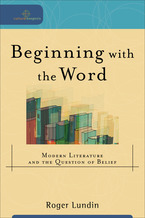
Beginning with the Word
Lundin, Roger. Beginning with the Word: Modern Literature and the Question of Belief. Grand Rapids: Baker Academic, 2014.
Lundin takes a look at literature and compares it to theology. Several years ago while visiting a church with a family member, the Sunday School class was exploring poetry and other literature and comparing it to the Bible. I really enjoyed the approach that Sunday School teacher had taken and was really hoping that this treatment would be of a similar vein. Instead, this book focuses far more on a philosophical and theoretical approach to theology and literature and is full of jargon that bogs down the narrative. Instead of being something that is likely to get an undergraduate or lay person interested in the topic, it is probably something that only faculty in theology, philosophy, and literature would find interesting and perhaps some graduate students in those fields. The author appears to be enjoy Emily Dickinson's poetry quite a bit because the book includes quite a bit. There are sections where the advance review copy omits poems due to license restrictions. It is well-written, researched, and documenting. The indexing is fairly comprehensive. In addition to the end notes, there is also a works cited section. This review is based on an advance review copy provided by the publisher through NetGalley with the expectation that a review would be written.
Saturday, May 31, 2014
The Sagebrush Singers
Kernecker, Herb. The Sagebrush Singers. Reno, Nev.: Humboldt American, 2014.
This is a retelling of the story of the Bremen Town Musicians with a southwestern American setting. A burro, a coyote, a skunk, and a crow head toward town to sing when they come across a band of rustlers. While I prefer the original story, this one should be entertaining for children. The illustrations are done by noted illustrator James Watts although they are not his best work. Although the book was released on May 15, the website advertised in the book has not been updated with the music and other features that were promised. Although the target audience is age 5 and up, I think younger children would enjoy it. My review is based on an advance e-galley provided by the publisher through NetGalley with the expectation a review would be written.
Tuesday, May 27, 2014
Goodnight, June
Jio, Sarah. Goodnight, June. New York: Plume, 2014.
What a fun read! June Anderson is a New York banker specializing in foreclosures. Her work has created life-threatening stress for her which she refuses to acknowledge. Suddenly she inherits her aunt's bookstore for children back in Seattle. June plans to take a week off and close it down just as she has closed down so many businesses over the years, but the bookstore still holds power over here. She meets a restauranteur in the adjacent space. The two of them hit it off well. There's a lot of resolution of family matters. The big thread in the novel is the friendship between her aunt and Margaret Wise Brown, author of Goodnight Moon and other children's stories. The letters June finds among her aunt's books point to her aunt's influence in the creation of the much beloved children's book. Ironically, June discovers that the bookstore is in financial trouble and finds herself on the opposite end of her banking role. Can she save the bookstore? I loved this book. You can tell that the author loves children's literature and literature itself. It may not be the most plausible story. There are more famous names dropped than could possibly actually occur, but even in spite of that, I loved the book. It's a fun and creative fictional look at what might have been the inspiration of a classic. This review is based on an e-galley received from the publisher through NetGalley for review purposes.
The Tastemakers
Sax, David. The Tastemakers: Why We're Crazy for Cupcakes But Fed Up with Fondue. New York: Public Affairs Books, 2014.
Have you ever wondered how food trends begin and end? Author David Sax takes a look at how some food trends began, why some of them decreased in popularity, and how some will likely continue. He also takes a look at political and economic factors in the food industry. He includes a bibliography for each chapter at the end rather than utilizing footnotes in his narrative. From cupcakes to Indian cuisine, from food trucks to fondue, he takes a look at the culture of food in American society. I found the book interesting in places but bogging down in others. The review is based on an advance e-galley provided by the publisher through NetGalley for review purposes.
Saturday, May 17, 2014
SNGF: Mother's Birthday
For this week's Saturday Night Genealogy Fun, Randy Seaver has challenged us with a set of questions regarding our mom's birthday.
1) What day of the week was your Mother born? Tell us how you found out.
Mom was born Saturday, 30 August 1924. [1]
2) What has happened in recorded history on your Mother's birth date (day and month)? Tell us how you found out, and list five events.
August 30, 1682 - William Penn set sail from England to the New World. [2]
August 30, 1850 - Honolulu becomes a city. [3]
August 30, 1862 - Confederates defeated the Union at the Second Battle of Bull Run. [4]
August 30, 1945 - General MacArthur lands in Japan. [5]
August 30, 1967 - Thurgood Marshall is confirmed as the first African-American justice of the United States Supreme Court. [6]
3) What famous people have been born on your Mother's birth date? Tell us how you found out, and list five of them.
August 30, 1797 - Mary Shelley, author of Frankenstein [7]
August 30, 1818 - Emily Bronte [8]
August 30, 1870 - Maria Montessori [9]
August 30, 1893 - Huey Long, governor or Louisiana [10]
August 30, 1930 - Warren Buffett, businessman [11]
4) Put your responses in your own blog post, in a comment on this blog post, or in a status or comment on Facebook or Google+.
It's obvious that I'm putting them on my blog!
[1] InfoPlease Perpetual Calendar, online resource, InfoPlease (http://www.infoplease.com/calendar.php : 17 May 2014).
[2] "Historical Events on 30th August," HistoryOrb.com (http://www.historyorb.com/events/august/30 : 17 May 2014).
[3] Ibid.
[4] "August 30," On this Day (http://www.on-this-day.com/onthisday/thedays/alldays/aug30.htm : 17 May 2014).
[5] "Historical Events on 30th August," HistoryOrb.com (http://www.historyorb.com/events/august/30 : 17 May 2014).
[6] "August 30," Wikipedia (http://en.wikipedia.org/wiki/August_30 : 17 May 2014), s.v. "Events."
[7] Ibid., s.v. "Births."
[9] "August 30," On this Day (http://www.on-this-day.com/onthisday/thedays/birthdays/aug30.htm : 17 May 2014), s.v. "Births."
[10] Ibid.
[11] "August 30," Wikipedia (http://en.wikipedia.org/wiki/August_30 : 17 May 2014), s.v. "Events."
1) What day of the week was your Mother born? Tell us how you found out.
Mom was born Saturday, 30 August 1924. [1]
2) What has happened in recorded history on your Mother's birth date (day and month)? Tell us how you found out, and list five events.
August 30, 1682 - William Penn set sail from England to the New World. [2]
August 30, 1850 - Honolulu becomes a city. [3]
August 30, 1862 - Confederates defeated the Union at the Second Battle of Bull Run. [4]
August 30, 1945 - General MacArthur lands in Japan. [5]
August 30, 1967 - Thurgood Marshall is confirmed as the first African-American justice of the United States Supreme Court. [6]
3) What famous people have been born on your Mother's birth date? Tell us how you found out, and list five of them.
August 30, 1797 - Mary Shelley, author of Frankenstein [7]
August 30, 1818 - Emily Bronte [8]
August 30, 1870 - Maria Montessori [9]
August 30, 1893 - Huey Long, governor or Louisiana [10]
August 30, 1930 - Warren Buffett, businessman [11]
4) Put your responses in your own blog post, in a comment on this blog post, or in a status or comment on Facebook or Google+.
It's obvious that I'm putting them on my blog!
[1] InfoPlease Perpetual Calendar, online resource, InfoPlease (http://www.infoplease.com/calendar.php : 17 May 2014).
[2] "Historical Events on 30th August," HistoryOrb.com (http://www.historyorb.com/events/august/30 : 17 May 2014).
[3] Ibid.
[4] "August 30," On this Day (http://www.on-this-day.com/onthisday/thedays/alldays/aug30.htm : 17 May 2014).
[5] "Historical Events on 30th August," HistoryOrb.com (http://www.historyorb.com/events/august/30 : 17 May 2014).
[6] "August 30," Wikipedia (http://en.wikipedia.org/wiki/August_30 : 17 May 2014), s.v. "Events."
[7] Ibid., s.v. "Births."
[9] "August 30," On this Day (http://www.on-this-day.com/onthisday/thedays/birthdays/aug30.htm : 17 May 2014), s.v. "Births."
[10] Ibid.
[11] "August 30," Wikipedia (http://en.wikipedia.org/wiki/August_30 : 17 May 2014), s.v. "Events."
Tuesday, May 13, 2014
The Girl Who Came Home by Hazel Gaynor
Gaynor, Hazel. The Girl Who Came Home: A Novel of the Titanic. New York: William Morrow, 2014.
Maggie Murphy was one of fourteen from the village of Ballysheen, Ireland aboard the Titanic. She was heading to America to live with an aunt after her mother's death, leaving behind the love of her life, Seamus Doyle in the village as he cared for his sick father. The story alternates between 1912 and 1982 when Maggie finally tells her story to her great-granddaughter, a journalist. One of the heroes of the book is a steward by the name of Harry Walsh who ensures that Maggie gets safely on board a lifeboat. The published story, of course, receives much attention by the press and brings with it some touching moments. I loved the historic story of the TItanic, but the parallel story of the present between Maggie's great-granddaughter Grace and Jimmy didn't have the punch that was probably intended. Fortunately, that is a minor part of the overall book, so the book was quite enjoyable. The book was received through LibraryThing's Early Reviewer program with the expectation that a review would be written.
Monday, May 12, 2014
NGS Recap
Randy Seaver was lamenting (on Facebook) the lack of posts last week during the NGS conference. I really didn't have a chance to post much. I was using my iPad to access the Internet although I had the laptop with me also. The only time I pulled it out was when I was giving my presentation on Wednesday. That went well, by the way.
Favorite sessions that I attended:
Food: We tried several local restaurants. The worst food and service award goes to the Hilton Garden Inn's restaurant. On that evening, we had a group of seven. We were the only people in the restaurant, and they couldn't seem to get the orders right and the food was horrible. I ordered crab cakes. They were quite dry. They didn't give you remoulade sauce or anything to cut that dryness. The worst part was that part of the crab shell was in my crab cake. I probably left more than I ate. It was pretty much inedible. Another person had a burger which he had ordered medium rare. It was way past well done. It had taken so long to get the food we got that he didn't dare send it back. The waitress had forgotten to take my "side" order which was supposed to accompany my meal so I had to wait on that after I got the crab cakes. On the good side, my side order of fries was actually hot as opposed the ones the others had gotten. The Best Food award goes to a place we found through Diners, Drive-Ins, and Dives. It was called "Dot's Back Inn." Burgers are their specialty. I had the one with the jerk seasonings, provolone cheese, and grilled onions. I think it was called the "Rasta." Jeff had the Greek one that had feta and tzatziki sauce. We both thought ours were great. We knew that they had a lot of burgers. We wished we'd tried it earlier because when we got there, we discovered that they had a menu of things on a hand-written board that were daily features. For example, there was a Moroccan-spiced swordfish with cilantro sauce. The fish of the day was shark that day. They had a shrimp and andouille sausage dish served on a bed of cheese grits that sounded quite yummy. They had blackened mahi and much more. They were also quite reasonably priced with most dishes being under $15. If we had not eaten at Mama J's (a soul food place near the convention center that was also quite good) at lunch, we might have tried one of the bigger meals instead of the burger that night. One of the highlights was a donut run we made with friends one evening. They were in search of a maple bacon donut at The Sugar Shack. They were out of that flavor, but we tried the Baby Ruth donut which was absolutely wonderful.
Exhibits: I didn't spend a lot of time in the exhibit hall except for my shift at the APG booth. It was small and crowded. I did manage to walk by most booths, but I just didn't spend money this time. My bank account thanks me although that is a bit odd for me not to purchase a little more than I did.
Hotel: The staff at the Marriott where I stayed was great. The valets who parked our cars were very service-oriented, making it a good experience every time I needed to get my car out.
All in all, it was a great conference!
Favorite sessions that I attended:
- "Hell on the Home Front: War-Time Damages and the Claims They Generated" by Elizabeth Shown Mills
- "North Carolina Research" by Jeff Haines
- "Shootout at the Rhododendron Lodge: Reconstructing Life-Changing Events" by Judy Russell
- "DNA and the Golden Rule: The Law and Ethics of Genetic Genealogy" by Judy Russell
- "Working with Documents: The Importance of Context in Record Analysis" by Barbara Vines Little
- "South Carolina Research" by Jeff Haines
Food: We tried several local restaurants. The worst food and service award goes to the Hilton Garden Inn's restaurant. On that evening, we had a group of seven. We were the only people in the restaurant, and they couldn't seem to get the orders right and the food was horrible. I ordered crab cakes. They were quite dry. They didn't give you remoulade sauce or anything to cut that dryness. The worst part was that part of the crab shell was in my crab cake. I probably left more than I ate. It was pretty much inedible. Another person had a burger which he had ordered medium rare. It was way past well done. It had taken so long to get the food we got that he didn't dare send it back. The waitress had forgotten to take my "side" order which was supposed to accompany my meal so I had to wait on that after I got the crab cakes. On the good side, my side order of fries was actually hot as opposed the ones the others had gotten. The Best Food award goes to a place we found through Diners, Drive-Ins, and Dives. It was called "Dot's Back Inn." Burgers are their specialty. I had the one with the jerk seasonings, provolone cheese, and grilled onions. I think it was called the "Rasta." Jeff had the Greek one that had feta and tzatziki sauce. We both thought ours were great. We knew that they had a lot of burgers. We wished we'd tried it earlier because when we got there, we discovered that they had a menu of things on a hand-written board that were daily features. For example, there was a Moroccan-spiced swordfish with cilantro sauce. The fish of the day was shark that day. They had a shrimp and andouille sausage dish served on a bed of cheese grits that sounded quite yummy. They had blackened mahi and much more. They were also quite reasonably priced with most dishes being under $15. If we had not eaten at Mama J's (a soul food place near the convention center that was also quite good) at lunch, we might have tried one of the bigger meals instead of the burger that night. One of the highlights was a donut run we made with friends one evening. They were in search of a maple bacon donut at The Sugar Shack. They were out of that flavor, but we tried the Baby Ruth donut which was absolutely wonderful.
Exhibits: I didn't spend a lot of time in the exhibit hall except for my shift at the APG booth. It was small and crowded. I did manage to walk by most booths, but I just didn't spend money this time. My bank account thanks me although that is a bit odd for me not to purchase a little more than I did.
Hotel: The staff at the Marriott where I stayed was great. The valets who parked our cars were very service-oriented, making it a good experience every time I needed to get my car out.
All in all, it was a great conference!
Subscribe to:
Posts (Atom)