Saturday, July 30, 2016

Announcing the "Neighbors" Series.

First of all, let me apologize for the lack of blog posts over the last week. I thought I had posts scheduled through the end of the month, but when I logged in last night, I discovered that I'd stopped a little shorter than I thought.

I will continue posting a few more pictures from my Oregon and Washington trip, but I will schedule those to run about every third or fourth post for the time being.

In genealogy, we always hear about the importance of researching the neighbors of our ancestors. When I first began my research, the common advice (back in the days of microfilm rolls instead of digital images) was to record the 10 people before and 10 people after one's ancestor's entry. I occasionally have heard a speaker extend this to 20 people in either direction. I generally compromise and go with about 15 as I've often spotted people just beyond the 10 that I knew were very connected to my ancestor.

My new series will focus on the neighbors of my ancestors. The blog will provide me with a means to shore up some of the research. Although I will not strive to research the neighbors at the same level of depth that I research my actual ancestors, I will probably dig a big deeper into each of them than I have in the past.

The hardest task, of course, was choosing which ancestor and which census year comes first. 

I decided to start with the census year selection first. My choice is 1880. I'll probably have to use the 1840 census for some persons, but the 1850 to 1870 censuses will be there for the backwards journey. I'll have to deal with the absences of the 1890 census in going forward, but the censuses and records from 1900 forward give more and more information. The censuses used, of course, will vary depending on the age of the neighbor in 1880.

I decided to begin with my maternal grandmother's father, Dock Hans Hester. When selected him, I knew I would end up with a lot of cousins and associates when selecting him which would provide excellent insight for readers into the importance of researching the neighbors. Many of these people are probably already in my genealogical database, but I suspect I will discover new things on each.

Although my ancestor, Dock Hans Hester was born in 1851, the 1880 census is the first in which he appears. The family lived in the "Lost Corner" area of Monroe County, Mississippi and was missed by enumerators in both the 1860 and 1870 censuses. I have read through the censuses for both Monroe and Itawamba Counties in 1860 and Monroe, Itawamba, and Lee (which was formed in 1866) for 1870. They just are not there. By 1880, Dock was already married. He married Mary Ann Harris on 20 Nov 1877 in Lee County, Mississippi.1 Dock, Mary Ann, and their daughter Georgia A. resided in Boyds Precinct, Monroe County, Mississippi in 1880.2 Although probably residing in the previous household, 16-year-old Watt Rawlins who boards is actually the person listed on the line with the dwelling and family number. He will be one of the persons researched in the series.

The neighbors (mostly head of household) by dwelling/family numbers:

114 - J. B. Hester; also residing in the house as a boarder is Watt Rawlins
112 - M. L. Morris; also residing in the house is Mrs. M. R. Wilson, his mother-in-law, and some of her children
109 - H. B. Ridings; also servants Lucinda Thomas and Sam Estes
108 - Jo Thomas
107 - J. D. Ridings
106 - Lee Jones
105 - J. M. Ridings
104 - H. Swinigen
103 - John Williams
102 - D. Ridings; also servant Jane Thomas
101 - O. G. Loveless
100 - J. D. Loveless; also sister-in-law F. J. Sterling

116 - Peter Lucas
117 - Patsey Bradley
118 - Sallie Lucas
119 - Thomas Gray
120 - G. W. Green
121 - J. D. Conwill
122 - J. F. Conwill
123 - J. W. Cook
124 - H. A. Black
125 - Bluford Hughs; also daughter-in-law S. J. Herndon
126 - Y. J. Conwill
127 - Mrs. N. F. Conwill; also boarder Nancy Gray
128 - J. C. Rawlins
129 - Jim Houston; also brother-in-law Steve Shumpert
130 - Mrs. A. Rhudy

I'll begin the series by researching those in households prior to Dock by order of proximity and then move to the ones residing after him.


1 Photocopy of D. H. Hester-Miss M. A. Harris marriage bond, Lee County, Mississippi marriage books, 20 Nov 1877. Incomplete citation in database that needs to be corrected; also "Mississippi Marriages, 1776-1935," database, Ancestry (http://www.ancestry.com : accessed 30 July 2016), entry for D. H. Hester-Miss M. A. Harris, 20 Nov 1877; citing Hunting For Bears, Mississippi Marriages, 1776-1935 (Provo, Utah: Ancestry, 2004).
2 1880 U.S. Federal Census, Monroe County, Mississippi, population schedule, Boyds Precinct, SD 1, ED 139, p. 294A (stamped), p. 11 (written), dwelling 115, family 115, lines 25-27, Dock Hester family; digital image, FamilySearch (https://familysearch.org/ark:/61903/3:1:33S7-9YBV-8DQ : accessed 30 July 2016); citing National Archives microfilm publication T9, roll 658.


Saturday, July 23, 2016

Portland Women's Forum and the Columbia River Gorge

Portland Women's Forum was on the road to Vista House and offered some good views of the Columbia River Gorge as well.

Portland Women's Forum sign
Samuel Hill Monument

Columbia River Gorge from Portland Women's Forum

Wednesday, July 20, 2016

Columbia River Gorge and Vista House

I wasn't exactly certain what to expect from the Columbia River Gorge. I think I expected it to be more "rugged" than it was. One of the best places to view the Gorge is at Vista House.

Vista House sign with the Gorge in the background
Vista House, as you can see, is an impressive structure.

Vista House
From this location, you can look out on the Columbia River Gorge.

Looking Northeast of Vista House
Closeup looking northeast of Vista House
Looking northwest of Vista House

It's a bird!

Sunday, July 17, 2016

Horsetail Falls and Bonneville Lock and Dam

Back to my series on my Oregon and Washington trip last month.

Several other waterfalls were in the vicinity of Multnomah Falls. My favorite was Horsetail Falls.

Horsetail Falls

I traveled on down the highway to the Bonneville Lock and Dam area.

Bonneville Dam
Bonneville Lock area

There were also some lovely flowers in the area of the lock and dam!

Beautiful Wildflowers
They also had a fish ladder where you could view some of the fish. The green-tinting to the glass made it impossible to really take good photographs of the fish making their way through the Columbia River. They did have a nice piece of art depicting the fish ladder at the hatchery.

Fish sculpture


Thursday, July 14, 2016

A Vietnam Casualty

As I read the online newspaper, I discovered distant cousins tried to rename the road on which my maternal grandparents lived for most of their married life (and my grandmother's parents before that). Descendants of Carlos Leroy "Bo" Tartt, a person about the age of one of my brothers who was a casualty in the Vietnam War, wanted the road named in honor of him and for the family who resided on the road.1 Carlos was the son of Clarence L. Tartt and his wife Marvelle Jean Lyle Tartt.2 They lived on Blackcat Bottom Road, just below what was B and B Cleaners back in the days I was growing up.

I was curious as to whether or not I could tie Carlos in with my grandmother's "Aunt Dollie" who married James M. Tartt on 25 August 1881 in Monroe County, Mississippi3 and then his brother Enos on 12 December 1893 in Monroe County4 or not. I decided to explore.

Clarence appears in the 1940 Monroe County, Mississippi census as the ten-year-old son of Edgar and Sadie Tart.5 Edgar appears on the 19006 and 19107 censuses as the son of John Chesley Tart, Jr. and his wife M. Alice. In the 1870 census, John C.  Tartt, Jr. along with brothers Enos and James appears as the son of John Chesley Tartt and his wife Elizabeth "Liza" Conwill.8 This means that Carlos was not directly related to me through Dollie. Dollie's children, however, would be related to this Vietnam "hero."


1 Emily Tubb, "City Rescinds Name Changing of Blackcat Bottom Road," Monroe Journal (Amory, Mississippi), 14 July 2016 (http://djournal.com/monroe/2016/07/14/city-rescinds-name-changing-blackcat-bottom-road/ : accessed 16 July 2016).
2 Clarence L. Tartt, obituary, Northeast Mississippi Daily Journal (Tupelo, Mississippi), 25 Feb 2009 (http://djournal.com/news/obituaries-feb-25-2009/ : accessed 14 July 2016).
3 Monroe County Mississippi Marriages (1821-1921) (s.l.: s.n, n.d.), Vol. 2, p. 261; Evans Memorial Library, Aberdeen, Monroe County, Mississippi; also Monroe County, Mississippi, Marriage Book ___, J. M. Tartt and Della A. Hester, 25 August 1881. A photocopy of the marriage record is in my possession, but it is not cited properly so I am unable to provide the book and page number. Something to add to the "to do" list.
4 Monroe County, Mississippi, Marriage Book __, E. A. Tart and Dolly Tart, 12 Dec 1893. A photocopy of the record is in my possession but is not properly cited with book and page number.
5 1940 U.S. Federal Census, Monroe County, Mississippi, population schedule, Beat 5, SD 1, ED 48-31, p. 438B (stamped), sheet 12B (written), visit 217, lines 50-55, Edgar Tart family; digital image, FamilySearch (https://familysearch.org/ark:/61903/3:1:3QS7-L9MR-JG29 : accessed 14 July 2016); citing National Archives Microfilm Publication T627, roll 2050.
6 1910 U.S. Federal Census, Monroe County, Mississippi, population schedule, Boyds Precinct, SD 1, ED 124, p. 72A (stamped), dwelling 5, family 5, lines 21-26, John C. Tart family; digital image, FamilySearch (https://familysearch.org/ark:/61903/3:1:33S7-9RKM-9Q33 : accessed 14 July 2016); citing National Archives microfilm publication T624, roll 752.
7 1900 U.S. Federal Census, Monroe County, Mississippi, population schedule, Beat 5, East of Aberdeen & Richmond Road, SD 1, ED 81, p. 270B (stamped), sheet 3B (written), dwelling 58, family 58, lines 87-95, J. C. Tart Junior family; digital image, FamilySearch (https://familysearch.org/ark:/61903/3:1:S3HY-XCHQ-FHQ : accessed 14 July 2016); citing National Archives microfilm publication T623, roll 822.
8 1870 U.S. Federal Census, Monroe County, Mississippi, population schedule, Township 12, Smithville post office, p. 218B (stamped), sheet 64 (written), dwelling 414, family 467, lines 6-15, John C. Tartt household; digital image, FamilySearch (https://familysearch.org/ark:/61903/3:1:S3HY-DC67-1VK : accessed 14 July 2016); citing National Archives microfilm publication M593, roll 741.

Sunday, July 10, 2016

Multnomah Falls

Oops! The "busy"-ness of the past week caught up with me, and I forgot to post yesterday. You'll get the intended post today. I'll try to post something a little more of a genealogy nature next time but today you get to enjoy more of my trip to Oregon and Washington.

On Monday, June 13 I left Portland fairly early in the morning and headed to Multnomah Falls. As you can see, they were breathtaking!

View from Parking Lot

Multnomah Falls


Good view of lower cascade

The upper cascade

Wednesday, July 06, 2016

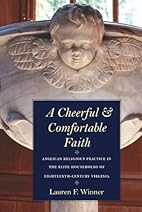
A Cheerful and Comfortable Faith


Winner, Lauren F. A Cheerful and Comfortable Faith: Anglican Religious Practice in the Elite Households of Eighteenth-Century Virginia. New Haven: Yale University Press, 2010.

With strong interests in genealogy, Christianity, and history, this book by Lauren Winner appealed to me. I have read a couple of Winner's books designed for lay audiences, but this particular volume has a decidedly academic tone. Winner explores the role the church, specifically the Anglican Church, played in the lives of 18th century well-to-do Virginia families. Many of these families were the owners of plantations and as such, exerted some influence over the lives of those who worked on their plantations. However, the influence did not always extend to the slaves as other groups such as the Baptists were more welcoming in sharing their services with those of color and even allowing them to serve as delegates. We see the influence extending from such things as embroidered samplers to meals and diet influenced by the church calendar to prayer life and even to the recording of genealogical information in Bible or other religious books. Probably my favorite part of the book was the discussion of the recording of genealogical information. Winner did extensive research for the volume, and it is well-documented. I intend to go through her extensive bibliography to locate sources I may find useful in my genealogical research. The biggest flaw of the book is in its readability, or lack thereof. This is not problematic for academics, genealogists looking for social history background to incorporate in their narratives are likely to ignore it. This is a book I intend to keep for reference.

Sunday, July 03, 2016

Portland Japanese Gardens


I recently traveled to the Pacific Northwest. The main purpose of my trip was to attend and present at the Association of Christian Librarians Conference which was being held at George Fox University in Newberg, near Portland. Since I had never been to Oregon or Washington, I decided to stay a little longer to do some sight-seeing. It was difficult to pick and choose what to visit and what would have to wait for another trip in the future (if I ever make it back).

My plane landed around noon Pacific time so it was too early to check into the hotel. I decided to visit Portland Japanese Gardens first. I'll include a few photos I took there.

A pagoda-like statue


One of my favorite scenes.

Supposedly the most photographed tree in the garden.

Feeding time for the coy.

Lovely flowering plants.
Beautiful flowers.

Man-Made Waterfall

View of Mount Hood from the Garden.

That was actually my second glimpse of Mount Hood that day. The first was up close and personal from the plane as we flew over it en route to PDX.

I enjoyed my visit to the Portland Japanese Garden and encourage others to visit when in the area.

Thursday, June 30, 2016

Mentoring in Genealogy

I was awakened early this morning by a text message arriving from a local news media outlet announcing Pat Head Summitt's death. Although the news of her imminent death came to us a couple of days earlier, it really did not mitigate our sense of loss when the news of her death was received.

Former Vol football player and NFL star Peyton Manning spoke of her friendship and support in a statement he released. He mentioned seeking her advice when he was trying to decide whether to turn pro early or to complete his final year of eligibility at University of Tennessee. He also spoke of the impact she had on players both on and off the court. Perhaps the most touching words of his entire statement came near the end of his statement. He said, "It would have  been a great experience to play for her. She could have coached any team, any sport, men's or women's. It wouldn't have mattered because Pat could flat out coach." As I looked at these words, I thought about the role of mentoring in genealogy. Are we as genealogists truly mentoring the next generation of genealogists in the same way Pat Summitt impacted her players? Pat kept her standards high, but her players learned so much. I think Elizabeth Shown Mills is a genealogist who fits the description. She continues to emphasize the "fundamentals" of sound genealogical research while taking her students to the next level. (I use "students" in the sense of those who took courses from her at IGHR or similar venues and those who attended lectures by her at national conferences or at regional or local venues.)

I am concerned because I see so many younger genealogical speakers emphasizing tools rather than fundamentals of sound research. I admit I sometimes have been guilty of the same thing, but I recently modified a couple of my presentations emphasizing tools (because they are in demand with societies) to include examples of sound genealogical research being presented in these tools. I do not know if everyone picks up on what I am trying to do, but I know from comments that some do. I hope all of us are conscious of our role in mentoring the next generation of genealogists and continue to emphasize the fundamentals in such a way it leads our mentees to reach the next level in their own research. 

Monday, June 27, 2016

Case Studies Demonstrating the Use of Mitochondrial DNA in Genealogical Research

This past weekend a researcher using a Facebook group asked a question about which DNA test to take. One person quickly chimed in that Ancestry DNA was the best. I came back and qualified it by asking for what goal the person hoped to achieve through testing. I explained that if it was a patrilineal question, a Y-DNA test might work better and that FamilyTreeDNA was the only American company currently offering such a test. I said Ancestry DNA and FamilyTreeDNA both provide good results, but suggested taking the Ancestry DNA test and then transferring the results to FamilyTreeDNA for $39. I also mentioned GEDmatch's usefulness.

Then I made a comment that in some very specific situations a mitochondrial DNA test might be useful. The other commenter thought mitochondrial DNA tests were a total waste of time. I reiterated that it is quite useful under very specific circumstance. I did, of course, mention my own reason for doing a mitochondrial test. Initially I wanted to learn the mitochondrial haplogroup to put to rest one of those full-blooded Indian rumors in my line. The haplogroup came back Western European so my goal was achieved. I also hoped it would help identify my 3g-grandmother's mother. That result is currently on hold as I need to work much more with the results to achieve it.

However, the discussion made me realize I needed some good examples of how mitochondrial DNA solved genealogical problems. My mind immediately went to Elizabeth Shown Mills' great article, "Testing the FAN Principle Against DNA: Zilphy (Watts) Price Cooksey Cooksey of Georgia and Mississippi," which first appeared in National Genealogical Society Quarterly in June 2014 and is now available on the author's Historic Pathways site. This case used all types of DNA, providing genealogists a great model for DNA research. I am sure I saw another published case study demonstrating mitochondrial DNA as a genealogical tool, but I could not remember it.

However, I did find a blog post by Roberta Estes, "Mitochondrial -- the Maligned DNA," which shows how mitochondrial DNA was used to resolve of which wife of a male ancestor the tester was a descendant.

I also found a somewhat technical but useful post by Blaine Bettinger, "An mtDNA Journey -- Discovering My mtDNA in a Research Paper," describing some of the surprises discovered in his own mitochondrial DNA and how he discovered his mtDNA in a research study defining his haplogroup.

I thought I'd toss the question out for others. Do you know of another example of a published case study involving mitochondrial DNA in DNA research? Has mitochondrial DNA been useful in your own line?

Bibliography

Bettinger, Blaine. "An mtDNA Journey -- Discovering My mtDNA in a Research Paper," The Genetic Genealogist, 30 July 2015 (http://thegeneticgenealogist.com/2015/07/30/a-mtdna-journey-discovering-my-mtdna-in-a-research-paper/ : accessed 25 June 2016).


Estes, Roberta. "Mitochondrial -- the Maligned DNA," DNAeXplained - Genetic Genealogy, 29 March 2014 (https://dna-explained.com/2014/03/29/mitochondrial-the-maligned-dna/ : accessed 25 June 2016).


Mills, Elizabeth Shown. "Testing the FAN Principle Against DNA: Zilphy (Watts) Price Cooksey Cooksey of Georgia and Mississippi." National Genealogical Society Quarterly 102 (June 2014): 129-152; image copy, Historic Pathways (https://www.historicpathways.com/download/ZilphyArticle072915.pdf : accessed 25 June 2016).

Friday, June 24, 2016

Memories

Yesterday, one of my friends from high school posted on Facebook that she had the song "Rhinestone Cowboy" stuck in her head. Most of us from that era know how difficult it is to remove that one from "auto-play."

I replied back that now it was stuck in the heads of all her friends except that I was singing a slightly different variation.

My brother's wife died, leaving behind an 18-month old son. For several years, I picked up my nephew from the babysitter's house after school let out and kept him until my brother returned home from work at Walmart, which was often late since he received a promotion to assistant manager and transferred to a store about 45 miles away. I would often play the radio, and sometimes it would be on as we were eating. I can still picture my nephew, sitting in his booster seat singing along with that song. He really only sang one phrase -- the phrase that was repeated often throughout the song and bore the title words. The problem was his vocabulary did not include the word "rhinestone" so he sang what he thought he heard. Yes, that song will forever be etched in my brain as "Macaroni on a Cowboy."

Tuesday, June 21, 2016

One More Quick Post - Mount Rainier

I'll try to resume my regular blogging schedule later in the week, but for now, I leave you with a photo of Mount Rainier that I took while in Seattle.


I leave for home tonight, arriving in the morning. I suspect the kittens (10 months old so almost officially cats) intend to keep me occupied tomorrow, but I should have time to think through a blog post the following day and get back to my blogging schedule.

Saturday, June 18, 2016

Having Too Much Fun to Remember to Post

I should have scheduled a post for this morning, but I'm having too much fun on my trip to Oregon and Washington to remember to do so.

Because I don't have lots of time at the moment for a long post, I'll leave you with a photo I took last Sunday afternoon at the Portland Japanese Gardens showing Mount Hood.

Mount Hood as seen from Portland Japanese Garden. Photograph by Lori Thornton, 12 Jun 2016.

Wednesday, June 15, 2016

Civil War Weapons

Springfield Model 1842. Photograph provided by "Older Firearms." Flickr Creative Commons (https://www.flickr.com/photos/35513864@N05/3292174456 : accessed 9 Jun 2016). Creative Commons Attribution-Share Alike License 2.0 Generic (CC BY-SA 2.0).

Last week my nephew asked a question on my Facebook page about my second great grandfather's military service in the Union Army during the Civil War. A third cousin once removed from the line private messaged me about the post. Her father left her the muzzle loader that was said to belong to James M. Thornton. She knew the gun was manufactured in 1850, but she knew little else about it.

I'm not exactly an expert on firearms, but my nephew knows much more about them. He served with the Army National Guard for two tours of duty in Iraq and is much more interested in them than I am. I put the "fourth cousins" in touch with one another in such a manner that I was copied on the messages.

After what seemed like a live Internet version of Antiques Roadshow, it was concluded that the gun was a Springfield Model 1842 and that it was one of the guns used in the war and issued with a modification that was present on the one in the family. When Union soldiers mustered out, they were given an option of purchasing their weapon. While we cannot guarantee this was the rifle issued to James M. Thornton, it seems likely that it was.

Sunday, June 12, 2016

Just the Facts, Please

Michael John Neill started a "rant" on Facebook the other day about Find A Grave. His basic wish is that Find A Grave would return to being a place to transcribe what is on the marker and provide a photograph without all the extra data provided.

It wasn't long before other genealogists were chiming in. Concern was voiced about the undocumented nature of much of the information being supplied. Many also knew of incorrect family connections. (I know someone had my maternal great-grandmother attached to the wrong man once even though they were in cemeteries in completely different parts of the state. Fortunately I was able to get this corrected.)

In the past I found instances where someone provided a citation for a grave recorded when the WPA inventories were made which is no longer marked. I appreciated the information.

However, I agree that much information being added is not useful. Some is completely erroneous. The contributors think they are being helpful, but they are likely being harmful. I know cousins who contact me about a person in my tree who "jumped" at the first match they found, making an incorrect conclusion concerning a person's identity based on a same name. The "reasonably exhaustive search" requirement was not met. This information gets propagated and sometimes creates situations where more incorrect information is available than correct. I spent a great amount of time trying to track down the source of erroneous information in one case so I could really address the error in a proof statement providing the correct analysis.

For the most part, I use the grave marker photograph as my source with Find A Grave. I make a note in my citation as to whether or not an accompanying photograph documents the evidence or not. In some cases, the accompanying photograph provides alternate information than the transcription. In those cases, I go with the photograph.


One person commenting on Neill's post said she likes to add death certificates, where available.

Of course, many persons are violating copyright when posting obituaries at Find A Grave. That has been a source of discussion among genealogists for a long time. That problem was around even before Find A Grave when persons would post every obituary in the local paper to Rootsweb Mailing Lists. At one time I was administrator for some of the boards. I contacted the papers involved to see if they claimed copyright on the obituaries or not. In one case, they did and wanted them removed. In another, the paper said they were created from form sheets filled in by the families so they did not. The question then became whether the family owned the copyright or if it was just "facts." After consultation with others, the decision was to remove those as requested by families only. Generally speaking, newspapers do claim the copyright to obituaries so they should not be posted.

One person said he did not mind the extra information. It placed it in one place, and he could evaluate it himself, much the same as he does with trees.

One person suggested Find A Grave needs to provide a section for the extra information that is separate from the main memorial.

I tend to agree Find A Grave is becoming too cluttered with all the extras. I do like the suggestion of a separate section for the additional information. I would also support requiring additional information to be cited. When an edit to that section is made, a box for a free-form citation could appear and not be accepted unless the citation was entered. Am I dreaming?

What are your thoughts?

Thursday, June 09, 2016

Cumberland Gap Genealogy Jamboree

The Cumberland Gap Genealogy Jamboree begins today in the area through which so many people had ancestors travel. This is a more relaxed genealogy event than many. Outside are crafts, re-enactments, and a few other events. Inside the National Park Visitor Center's auditorium are presentations by known regional and national speakers. The event runs through Saturday.

I won't be attending today's festivities as I'm using the time to do laundry and pack. I have a work-related conference for which I'm leaving as soon as I finish speaking Saturday. Because I plan to attend most of Friday and Saturday, I needed today to get ready (and to spend a little time with my kittens who are quickly becoming full-grown cats).

I'm looking forward to visiting with many friends at the event, but this year's event will be a little sad as Connie won't be there. Connie was from the Evansville, Indiana area and always came. I always enjoyed visiting with her and Lyn at the booth they set up to sell "extra copies" of genealogy books to benefit the Willard Library. A distant "cousin" Mary also usually came and visited. [I say she's a "cousin" even though the connection is not proven. We know it will be there once we discover from which line my ancestor descends. Regardless of the line, we'll end up being related.]

Things will be different, but are things ever "the same" again?

Monday, June 06, 2016

Handy Mississippi Genealogy Handbook


Morris, Gary L. Handy Mississippi Genealogy Handbook. s.l.: s.n., 2015.

As I was browsing at Amazon this week, I discovered an entry for a book on Mississippi genealogical research previously unknown to me. Even though the book was described as being 38 pages and costing $5.99, I decided to purchase it. When the book arrived, it really only had 36 pages. The book relies heavily upon Access Genealogy resources. Most other information is a listing of URLs or addresses.

The layout and formatting is confusing. The author uses the same heading style for sections as for the actual resource, making much of the information seem duplicated. Descriptions are not very useful and information provided is not complete enough to be useful at even a basic level.

The final section of the book provides a listing of common Mississippi surnames -- or what is SUPPOSED to be a listing of common Mississippi surnames. Instead, it is a listing of counties.

Don't waste your money on this volume! What little useful information included can be found easily on the Internet. Those wanting a book on Mississippi research are better off purchasing the dated Tracing Your Mississippi Ancestors by Anne S. Lipscomb and Kathleen Hutchison.

Friday, June 03, 2016

Genealogical Filing Systems Over the Years

When I first began doing genealogy years ago, I had little rhyme or reason to my filing. I had a bunch of folders that had paper in them. They were roughly sorted by "broad" family groups.

I quickly discovered that didn't work very well and broke them into smaller groups and into counties and such.

I think I visited a cousin who was into scrapbooking and saw the merits of notebooks. I created notebooks for most of the families. I made individual and/or family group sheets for each person. I filed documents pertaining to each behind the sheet. Unfortunately that didn't really work either, but for a long time I really didn't know a better way to do it. I still had a lot of stuff in folders that never made it to the new system. I probably began filing in either the notebook or a folder.

When talking with another genealogist, I learned his system was filing by the record. So if it was Monroe County, Mississippi Deeds, with his system, I'd put them in a folder (or folders) arranged so book 1 deeds were inserted by pages, then book 2, then book 3, etc. This meant that as long as I had my citation, I could find them. Correspondence folders could be arranged by the correspondent instead of by the family or families to which they pertained, which really helped when it came to e-mails that covered multiple families. Although I've begun rearranging my folders, I've got a long way to go on the project.

You may wonder why I chose to post on this topic. It's really simple. I planned a post to discuss evidence and reach a conclusion based on the genealogical proof standard. Additional information came to my attention tonight. It doesn't seem all that reliable on the surface, but it adds a new twist, and I need to look at documents again that are under multiple filing systems in my house. I cannot even remember which records are in some of those older files that may not be in my database. If certain ones are not present, I need to retrieve those from several locations before the reasonable exhaustive search has been made. Most of the documents I need will be in Monroe or Itawamba County, Mississippi or Fayette County, Alabama. Some may not exist, but I need to be certain of that and make sure that my search has been written up so I don't forget what I've done. It's been a long time since I really worked on this line (until recently), and it is finally being written up as it should have been 20 years ago.

We all need to revisit our old research and make sure it meets standards. I find that too much reliance on a database is not good for me. I do use one, but I need to write research reports to myself and then write a documented narrative. That is what works best for me!

Tuesday, May 31, 2016

Reunited

Pardon me if I borrow the title of a song from my high school years, but it seems to fit the topic of today's post. I just returned from my high school reunion. I was a bit disappointed in the turnout. Of course, I expected the turnout to be low. We really did not receive notification of the date until 3 months ago. Pricing and details only came to us in April. I suspect many of my friends had already planned other things for a holiday weekend. Others probably could not arrange to get off work on such notice when others in their places of employment had already requested days around the long weekend.

In spite of the low turnout, those of us who attended enjoyed visiting and reminiscing. I suspect most of us could have done without the DJ and the music that was mostly just interrupting our conversations. A few did dance, but there was little floor space available at our venue. I'd love to post a photo but I have not obtained permission to post one of the group shots some of my friends' spouses' took.

I'm really probably more excited about things that took place earlier in the day. I met with some cousins on my grandmother's paternal line at lunch. We then went out to where they were camping by the gravel pits around Bigbee to get a Y37 plus Family Finder sample. This will be in tomorrow's mail so the waiting begins. We already know where the autosomal DNA is pointing, but it will be interesting to see if we can identify a more specific line with the Y-DNA, perhaps through a mutation. We are showing matches to two branches with differing migration patterns. Persons from both of these areas migrated to the areas in Alabama and Mississippi where our ancestors resided. Hopefully we'll be able to bridge the gap.

After that, I went to my dad's first cousin's house where we attempted to identify all the people not previously identified in the 1984 reunion photograph. We managed to identify some of them. Most of those not identified were the younger children. We enjoyed visiting until it was time for her to go to her granddaughter's birthday party and for me to go to my reunion. We'd love to have another family reunion, but there are fewer and fewer first cousins, and the younger generations don't seem to care as much about getting together. Many of the older ones are unable to travel on their own.

Saturday, May 28, 2016

Thoughts on New Ancestor Discoveries

Last week many people were excited about the "new" New Ancestor Discoveries rolling out on Ancestry DNA. I decided to take a look at them. I listed the New Ancestor Discoveries along with their dates for the kits I manage on Ancestry and made columns for each kit I manage. What surprised me was how little overlap my brother and father had. I had more overlap with my dad than he did, but even that wasn't perfect. For example, Dad had a hint for Malachi Watts (1793-1871) while I had a hint for Malachi's father Garrett Z. Watts (1756-1838). While I haven't figured out the exact connection for this line, I have a "hunch." I need to work forward on some of Garrett's lines to see if I can find the connection. What makes this an interesting match is Garrett's mother is supposed to be Cherokee. Our admixture shows no Native American, but of course, admixture is not very reliable. The trees from our "matches" show several variants of Garrett's mother's name.

I recognized some of the suggestions. Cassandra Parrish is a daughter of Allen Parish and his wife Elizabeth, both of whom are already in the tree. I suspect Cassandra came up as a hint because of the spelling variation and absence of a surname for her mother. John Chism is the husband of John Sheppard Anglin's sister Mary "Polly". The connection is really on Polly's parents William M. Anglin and Elizabeth "Betsy" Sheppard. Ann Eliza Abernathy is the wife of Mary Ann Harris's brother Charles Newton Harris. The common ancestors in that case are Walton A. Harris and Margaret Mosely. Several more with similar situations to these exist.

However, a handful of matches potentially useful in expanding a couple of lines are present. Our John Allred's father is unknown. We have long suspected Isaac who is "running around" the same parts of Tennessee, Mississippi, and Alabama is probably a brother. Autosomal DNA confirms a kinship between the two although it cannot be determined if the relationship is sibling or cousin. Several Allreds show up in our matches: James Allred (1784-1876), Reuben Warren Allred (1815-1896), and Nancy Cynthia Allred (1840-1901). James is the person some people try to say is John's father. Unfortunately the evidence is not strong enough at this point, and I still need to complete a reasonably exhaustive search before I can build a case. Reuben and Cynthia are too young to be parents, but their family ties may help us establish a connection.I'm also excited about an Abigail Harris (1817-1889). I glanced at it quickly. It appears she was attached to a John Harris I suspect may be Walton's grandfather although she is more the age to be a sibling to Walton. I will want to see if the online tree in the "quick view" in New Ancestor Discoveries differs from the individual trees of persons we match. It's possible the trees omitted a generation also.

New Ancestor Discoveries are, therefore, a mixed bag. In most cases, the "ancestor" is probably a different relationship, but the hint received may be useful.